

Five Innovations in the Data Storage Landscape

As part of an effort to revamp its entire approach to storage, IBM today unveiled a set of IBM Spectrum Storage offerings that extends the reach of its portfolio of software-defined storage software to third-party products for the first time.
Vincent Hsu, IBM Fellow and CTO for IBM Storage Systems, says the IBM Spectrum Storage portfolio combines the storage software that IBM gained with the acquisition of XIV in 2008 with the General Parallel File System (GPFS) that IBM originally developed to drive mainframe storage, to create a software-defined storage architecture that can dynamically scale both up and out.
Hsu says that IBM Spectrum Accelerate management software can be deployed on premise or as a cloud service on top of any storage infrastructure, which means that, for the first time, IBM is supporting storage hardware it did not manufacture. That capability is provided by separating the control and data management planes in storage in much the same way providers of network infrastructure have done to create software-defined networks (SDNs), says Hsu.
Core features of the IBM Spectrum Accelerate management software include support for snapshots, synchronous and asynchronous replication, multi-tenancy, self-provisioning, RESTful application programming interfaces (APIs), support for the OpenStack cloud management framework, and integration with VMware vCloud Suite software.
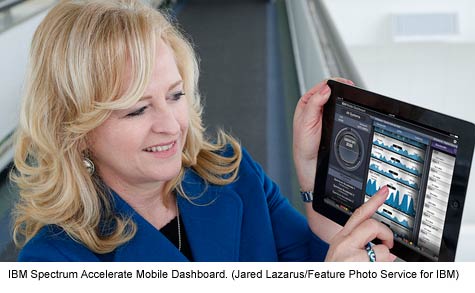
As part of that effort, IBM has developed a graphical user interface GUI) that can be run on any browser-enabled device. Dubbed Hyper-Scale Manager, the GUI enables administrators to manage storage through a mobile dashboard.
IBM also plans to later this year introduce a multi-cloud connecter as an integrated element of IBM Spectrum Storage that will securely make it easier to migrate data across multiple clouds using Hyper-Scale Manager.
The end result, says Hsu, is a policy-driven storage architecture that makes use of open application programming interfaces to give IT organizations more control over data regardless of where it happens to be physically stored.
Hsu says that IBM is committing a billion dollars to the ongoing development of software-defined storage over the next five years. Longer term, it remains to be seen how much the management of storage and networking will converge in the era of the software-defined data center. But the days of manually managing isolated storage systems are rapidly coming to a close.