

Software-Defined Storage: Driving a New Era of the Cloud

Interest has been rising in the idea of reinventing enterprise networking using a set of modular software components that run on commodity servers and other forms of commercial silicon. And as a provider of switches and a software-defined networking (SDN) environment that runs on commercial silicon from Broadcom, Big Switch Networks has found itself at the forefront of the movement.
Now Big Switch Networks is moving to take the idea a step further with the introduction of Big Cloud Fabric, which enables Big Switch Networks customers to create a hyperscale networking environment based on Layer 2 switches and controllers rather than proprietary ASIC processors.
Kyle Forster, vice president of marketing for Big Switch Networks, says Big Cloud Fabric combines the latest version of the Big Tap monitoring platform and SDN software along with the company’s Switch Light Operating System to create a physical leaf and spine networking architecture that is much more efficient and less costly to deploy than traditional switches.
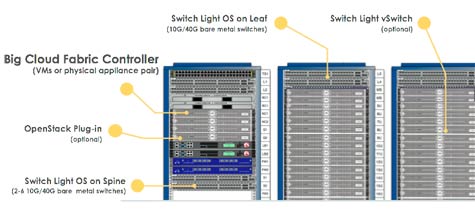
Rather than viewing SDNs as a more efficient way to manage traditional switches, Forster says the rise of SDNs creates an opportunity to fundamentally rethink how switches are built, deployed and managed across the data center. In fact, Forster notes that companies, such as Google, that manage IT at scale have already made that transition by building their own switches. Big Switch Networks, says Forster, is simply providing that same opportunity to the enterprise without requiring them to build their own switches from the ground up.
The rise of virtualization and cloud computing is putting more pressure on enterprise networks that were never designed to support the huge workloads running on virtual machines, which are all trying to access the same network resources. At this point, it’s not a matter of if those networks are going to be redesigned but when. However, the exact form those next-generation networks will take isn’t yet clear.