SHARE
Facebook X Pinterest WhatsApp

Terracotta Provides Insights into Big Memory

As in-memory computing gets more sophisticated, it’s becoming apparent that there are going to be multiple tiers of memory that need to be managed just like there are multiple tiers of storage. To address that issue, Terracotta, a unit of Software AG, today at the CeBit 2013 trade show unveiled Terracotta In-Genius, a data management […]

Written By
MV
Mike Vizard
Mar 4, 2013

As in-memory computing gets more sophisticated, it’s becoming apparent that there are going to be multiple tiers of memory that need to be managed just like there are multiple tiers of storage.

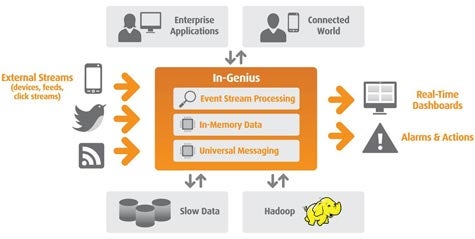
To address that issue, Terracotta, a unit of Software AG, today at the CeBit 2013 trade show unveiled Terracotta In-Genius, a data management tool that helps automate the management of memory resources across as many as one million event transactions per second.

According to Andy Raskin, Terracotta senior director of product marketing, Terracotta In-Genius is designed to allow organizations to manage multiple tiers of memory at scale in real time. Based on version 4.0 of Terracotta’s Big Memory in-memory data store, Terracotta In-Genius discovers patterns in data usage that can be used to optimize the allocation of memory in a way that is transparent to the application, says Raskin.
viz20130304-01

The rise of multicore processors and Flash technologies has made more affordable memory available than ever. But one of the challenges that remain is making all that new processing power available to developers in a way that automates routine tasks such as a garbage collection process that currently limits the degree to which Java applications can currently scale running in memory.

Raskin says Terracotta In-Genius coupled with Big Memory in-memory data store is designed to manage all those memory resources at a level of abstraction that doesn’t require the application developer to manage specific memory resources or acquire a specialized in-memory computing platform such as the SAP High Performance Analytics Appliance (HANA).

In-memory computing can improve application performance by a factor of three to 1,000 by eliminating calls to disk-based storage. That may not necessarily eliminate the need for disk-based storage all together. But by reducing the dependency on disk-based storage it is clear applications are about to make several quantum leaps forward in terms of performance.

MV

Michael Vizard is a seasoned IT journalist, with nearly 30 years of experience writing and editing about enterprise IT issues. He is a contributor to publications including Programmableweb, IT Business Edge, CIOinsight and UBM Tech. He formerly was editorial director for Ziff-Davis Enterprise, where he launched the company’s custom content division, and has also served as editor in chief for CRN and InfoWorld. He also has held editorial positions at PC Week, Computerworld and Digital Review.

Recommended for you...

Best IoT Device Management Platforms & Software 2022
Llanor Alleyne
May 21, 2021
Enterprise End-to-End Encryption is on the Rise
Llanor Alleyne
May 17, 2021
HP and the “Never Give Up” Rule
Rob Enderle
Feb 5, 2021
IT Business Edge Logo

The go-to resource for IT professionals from all corners of the tech world looking for cutting edge technology solutions that solve their unique business challenges. We aim to help these professionals grow their knowledge base and authority in their field with the top news and trends in the technology space.

Property of TechnologyAdvice. © 2025 TechnologyAdvice. All Rights Reserved

Advertiser Disclosure: Some of the products that appear on this site are from companies from which TechnologyAdvice receives compensation. This compensation may impact how and where products appear on this site including, for example, the order in which they appear. TechnologyAdvice does not include all companies or all types of products available in the marketplace.