
The management of servers has become more challenging because more workloads than ever are trying to access a common pool of infrastructure resources. To make it simpler to dynamically allocate infrastructure resources across multiple workloads, TidalScale today unveiled a management framework that allows IT organizations to right-size data center resources to match the specific requirement of any given workload.
Chuck Piercey, head of product management for TidalScale, says TidalScale WaveRunner makes it easier for IT administrators to invoke TidalScale HyperKernel software that TidalScale earlier developed to provide a framework based on machine learning algorithms that precisely matches server resources to the requirements of an application workload. The goal behind that effort, says Piercey, is to reduce overprovisioning of servers to guarantee performance that in the end winds up wasting infrastructure resources.
“There’s a lot of uncertainty that leads to overprovisioning,” says Piercey.
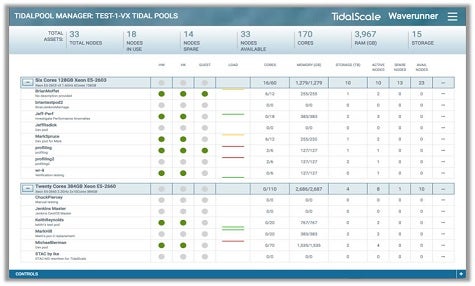
Via TidalScale WaveRunner, Piercey says, IT organizations can now layer a control plane running as a guest operating system on top of a virtual machine across a software-defined data center (SDDC) that invokes the REST application programming interfaces (APIs) built into TidalScale HyperKernel. That control plane, adds Piercey, can be extended to include the management of storage area networks and virtual local area networks (VLANs) as well. Piercey says TidalScale WaveRunner is unique in that it enables IT organizations to not only move workloads within a software-defined data center, but processor resources can also be moved as needed.
In effect, Piercey says, TidalScale is making it possible for IT organizations to create pods of infrastructure resources that can be allocated to entire applications or as granular sets of microservices based on Docker containers. Those pods in turn can be programmatically invoked via REST APIs that are now exposed via Tidal WaveRunner, adds Piercey.
A lot of SDDC promises have been made by vendors that in many instances made managing the data center more complex rather than simpler. As management frameworks based on REST APIs become more prevalent, however, the promise of software-defined infrastructure should increasingly become an everyday reality, regardless of the underlying virtual or physical infrastructure resources being employed.