
As interest in the open source Hadoop framework for managing large amounts of data has grown, the one vendor in the data management space that has been virtually silent about Hadoop is Oracle.
One of the reasons for this has to do with the fact that when it comes to ‘Big Data’ Oracle would prefer customers to buy something like its Exadata appliance, which is now based on hardware technologies that Oracle acquired via its purchase of Sun Microsystems.
Despite Oracle’s apparent reticence, more customers are looking to Hadoop as a complement to their database investments. For example, rather than storing everything in Oracle, many companies are moving toward a hybrid model that will allow them to store data that is hardly ever used in the Hadoop format. This allows them to substantially reduce their database license fees, while still making that data available.
One company helping to facilitate this scenario is Quest Software, which this week rolled out OraOop, a faster version of an open source connector developed in conjunction with Cloudera that customers can use to connect Hadoop to Oracle databases.
According to Christian Hasker, director of product management at Quest, enterprise customers need an implementation of the open source Scoop connector such as OraOop that is faster because of the performance requirements of most Oracle customers.
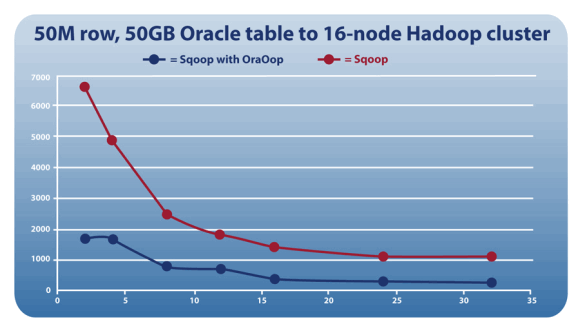
Overall, Hasker expects to see a hybrid ecosystem emerge across Oracle and Hadoop employments that will make use of OraOop and Toad for Cloud tools that Quest has come up with to allow customers with SQL expertise to access the growing number of data management solutions that don’t support SQL.
While some database administrators may resist Hadoop given all the noise surrounding the No SQL movement, when you take a step back and consider Hadoop as a complement to SQL databases, a new lower cost data management strategy starts to emerge. In fact, that strategy has not been lost on companies, such as IBM, that aggressively embraced Hadoop.
And while it’s true that most SQL databases can handle the Big Data requirements of most IT organizations, a SQL database approach can be prohibitively expensive. Hadoop, on the other hand, provides a lower-cost option that while not meant to replace SQL databases, takes a lot of pressure off the overall IT budget.