SHARE
Facebook X Pinterest WhatsApp

Excelero Brings Flash Storage on Servers Together in a Mesh

At a time when primary data is increasingly being stored in Flash memory directly attached to a server, finding a way to make that data readily accessible to multiple servers has become a challenge. To address that issue, Excelero this week made available version 1.1 of NVMesh Server SAN software that makes it possible for […]

Written By
MV
Mike Vizard
Mar 9, 2017

At a time when primary data is increasingly being stored in Flash memory directly attached to a server, finding a way to make that data readily accessible to multiple servers has become a challenge.

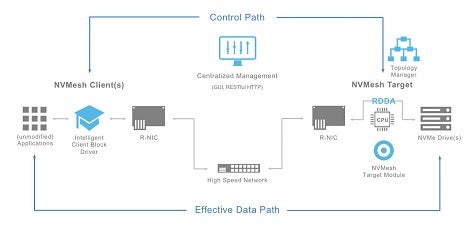
To address that issue, Excelero this week made available version 1.1 of NVMesh Server SAN software that makes it possible for applications to see any logical volume regardless of where it happens to be physically located within a cluster.

Rather than being required to acquire dedicated storage hardware to share access to data, Josh Goldenhar, vice president of products, says NVMesh Server SAN software takes advantage of an NVMe backplane and network interface cards compatible with the Remote Direct Drive Access (RDDA) protocol.

That approach, says Goldenhar, means that IT organizations can configure an industry standard server with solid-state drives (SSDs) and Excelero software to provide millions of IOPs across hundreds of thousands of nodes of block storage at a fraction of the cost of dedicated SAN systems.

That performance, adds Goldenhar, is achieved without adding any overhead to the CPUs in any servers attached to that system.

Goldenhar says the core concept for NVMesh Server SAN puts techniques that web-scale companies have been using to drive massive I/O performance into an application that the average enterprise can consume.

“IT organizations can now do what hyperscaler companies have been doing for years across hundreds of developers,” says Goldenhar.
Excelero

Flash memory is arguably the most transformative storage technology to come down the proverbial pike in a very long time. The issue now is to what degree IT organizations want to continue employing Flash memory within legacy storage architectures versus rethinking the entire paradigm altogether.


MV

Michael Vizard is a seasoned IT journalist, with nearly 30 years of experience writing and editing about enterprise IT issues. He is a contributor to publications including Programmableweb, IT Business Edge, CIOinsight and UBM Tech. He formerly was editorial director for Ziff-Davis Enterprise, where he launched the company’s custom content division, and has also served as editor in chief for CRN and InfoWorld. He also has held editorial positions at PC Week, Computerworld and Digital Review.

Recommended for you...

Observability: Why It’s a Red Hot Tech Term
Tom Taulli
Jul 19, 2022
Top GRC Platforms & Tools in 2022
Jira vs. ServiceNow: Features, Pricing, and Comparison
Surajdeep Singh
Jun 17, 2022
IT Business Edge Logo

The go-to resource for IT professionals from all corners of the tech world looking for cutting edge technology solutions that solve their unique business challenges. We aim to help these professionals grow their knowledge base and authority in their field with the top news and trends in the technology space.

Property of TechnologyAdvice. © 2025 TechnologyAdvice. All Rights Reserved

Advertiser Disclosure: Some of the products that appear on this site are from companies from which TechnologyAdvice receives compensation. This compensation may impact how and where products appear on this site including, for example, the order in which they appear. TechnologyAdvice does not include all companies or all types of products available in the marketplace.