

Digital Integration: Overcoming Enterprise Data Challenges

Rather than call IT every time an issue arises, many end users now routinely make use of “time machine” capabilities provided by Microsoft and Apple to refresh and literally restore their systems back to a time before the issue. Now Datos IO is applying that same concept to NoSQL databases.
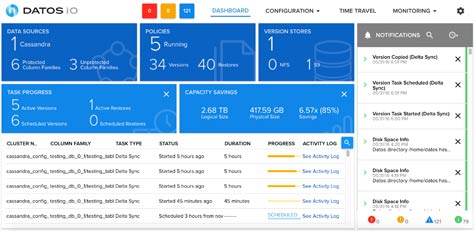
Datos IO CEO Tarun Thakur says RecoverX, now generally available, can be configured to enable IT organizations to capture data in a variety of NoSQL databases every few minutes. In the event the database is corrupted or goes offline, the IT organization can then bring that copy of the NoSQL database online in a matter of minutes.
Designed to support Apache Cassandra, DataStax DSE and MongoDB databases, RecoverX can be used in conjunction with both NAS storage in on-premise environments and Amazon S3 storage and Google Cloud Storage in the cloud. It is based on a Consistent Orchestrated Distributed Recovery (CODR) architecture that runs independently of media servers, and RecoverX transfers data in parallel to and from file-based and object-based secondary storage systems, automatically deduplicating that data. RecoverX, says Thakur, can be configured to transfer data at any interval and granularity, and that data can then be recovered in minutes via a single click.
Given the vast amounts of data that now reside in these NoSQL databases, Thakur says traditional approaches to backup and recovery are no long viable. Not only is backing up that amount of data impractical, Thakur says that the time it takes to recover that data using those tools often creates an untenable situation for the business.
As NoSQL databases continue to become more widely deployed across the enterprise, IT organizations are encountering all kinds of data management challenges. But job one for most IT organizations is to make sure the data in those databases is always available. That may mean losing a miniscule amount of data from time to time. The alternative, of course, is to have those databases be offline for an extended period of time, which usually results in a conversation with the business leadership that most IT executives would rather not have.