
SHARE
Facebook X Pinterest WhatsApp

ABBYY Helps Simplify Building of Cognitive Computing Applications

Automating the Intelligence of Business Intelligence Thanks to the commercialization of platforms such as IBM Watson, interest in all things relating to cognitive computing is running high. But actually building these applications is a major challenge because identifying the relationships between various facts and events requires building a library of terms and definitions that applications […]

Written By
MV
Mike Vizard
Feb 11, 2016
Slide Show

Automating the Intelligence of Business Intelligence

Thanks to the commercialization of platforms such as IBM Watson, interest in all things relating to cognitive computing is running high. But actually building these applications is a major challenge because identifying the relationships between various facts and events requires building a library of terms and definitions that applications can leverage to make an actual cognitive recommendation.

To help address that issue, ABBYY, a provider of data capture software, this week launched an ABBYY Compreno suite of software tools that leverages ontology and machine learning algorithms to enable developers to create analytics applications that understand the context between facts and even entire story lines within a text document.

David Bayer, vice president for the Compreno Suite at ABBYY, says ABBYY Compreno consists of an ABBYY InfoExtractor software development kit based on REST application programming interfaces that make it simpler to embed this capability in a cognitive computing application, and ABBYY Smart Classifier, an application that makes it simpler to organize various classes of data.
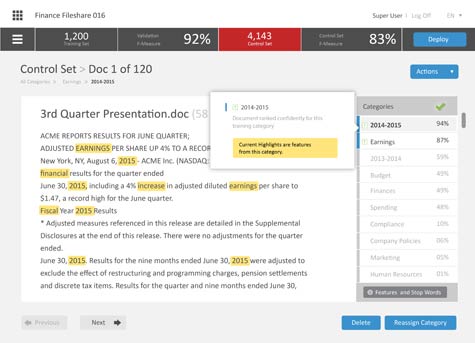
ABBYY-Smart-Classifier-Features

In general, Bayer says, there are two approaches to building cognitive computing applications. The first employs a statistical model, while the second makes use of linguistics to more accurately capture the relationship between different passages of text.

Regardless of the approach taken, IT organizations trying to build cognitive computing applications are spending an inordinate amount of time building the content libraries these applications rely on to analyze text. The number of cognitive computing applications that actually make it into production should substantially grow once the time required to build those content libraries is substantially reduced.

MV

Michael Vizard is a seasoned IT journalist, with nearly 30 years of experience writing and editing about enterprise IT issues. He is a contributor to publications including Programmableweb, IT Business Edge, CIOinsight and UBM Tech. He formerly was editorial director for Ziff-Davis Enterprise, where he launched the company’s custom content division, and has also served as editor in chief for CRN and InfoWorld. He also has held editorial positions at PC Week, Computerworld and Digital Review.

Recommended for you...

Observability: Why It’s a Red Hot Tech Term
Tom Taulli
Jul 19, 2022
Top GRC Platforms & Tools in 2022
Jira vs. ServiceNow: Features, Pricing, and Comparison
Surajdeep Singh
Jun 17, 2022
IT Business Edge Logo

The go-to resource for IT professionals from all corners of the tech world looking for cutting edge technology solutions that solve their unique business challenges. We aim to help these professionals grow their knowledge base and authority in their field with the top news and trends in the technology space.

Property of TechnologyAdvice. © 2025 TechnologyAdvice. All Rights Reserved

Advertiser Disclosure: Some of the products that appear on this site are from companies from which TechnologyAdvice receives compensation. This compensation may impact how and where products appear on this site including, for example, the order in which they appear. TechnologyAdvice does not include all companies or all types of products available in the marketplace.