
SHARE
Facebook X Pinterest WhatsApp

Teradata Launches Borderless Analytics Initiative

How to Find Business Value in Your Data Through Modernization At a Teradata Partners 2016 conference today, Teradata announced that it is not only making its database available on both public and private clouds, IT organizations for the first time will be able to launch queries against those databases as if they were one logical […]

Written By
MV
Mike Vizard
Sep 12, 2016
Slide Show

How to Find Business Value in Your Data Through Modernization

At a Teradata Partners 2016 conference today, Teradata announced that it is not only making its database available on both public and private clouds, IT organizations for the first time will be able to launch queries against those databases as if they were one logical entity.

Via a Borderless Analytics initiative, Teradata is extending the reach of Teradata QueryGrid and Teradata Unity to make it possible to create queries that can be launched across up to 32 logical Teradata nodes that IT organizations can also from a management perspective orchestrate, according to Imad Birouty, director of Teradata product marketing.

Meanwhile, via a complementary Teradata Everywhere initiative also announced today, those instances of Teradata can now run on Amazon Web Services and Microsoft Azure public clouds in addition to clouds managed by Teradata. Teradata databases can also be deployed on top of VMware or using the Teradata IntelliFlex platform that IT organizations can deploy themselves.

A Teradata Adaptive Optimizer also automatically adjusts to whatever host environment is being employed, while a MAPS feature makes it simpler to balance data distribution across geographically distributed databases to help ensure high availability.
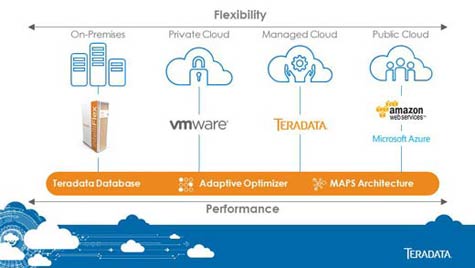
Teradata-Everywhere-Graphiic

Birouty says that as cloud computing continues to evolve, from a programming perspective where any given database is located is going to be less relevant.

“A lot of programmers may not even know where the database is,” says Birouty.

Arguably, over time the actual data repository being employed will also become less relevant. IT organizations will be employing a mix of database types to drive advanced analytics applications. The challenge now will be figuring out how that capability is going to be actually employed to create analytics applications that previously would have been too complex for most IT organizations to consider building.

Save

Save

Save

Save

MV

Michael Vizard is a seasoned IT journalist, with nearly 30 years of experience writing and editing about enterprise IT issues. He is a contributor to publications including Programmableweb, IT Business Edge, CIOinsight and UBM Tech. He formerly was editorial director for Ziff-Davis Enterprise, where he launched the company’s custom content division, and has also served as editor in chief for CRN and InfoWorld. He also has held editorial positions at PC Week, Computerworld and Digital Review.

Recommended for you...

Top ETL Tools 2022
Collins Ayuya
Jul 14, 2022
Snowflake vs. Databricks: Big Data Platform Comparison
Surajdeep Singh
Jul 14, 2022
Identify Where Your Information Is Vulnerable Using Data Flow Diagrams
Jillian Koskie
Jun 22, 2022
IT Business Edge Logo

The go-to resource for IT professionals from all corners of the tech world looking for cutting edge technology solutions that solve their unique business challenges. We aim to help these professionals grow their knowledge base and authority in their field with the top news and trends in the technology space.

Property of TechnologyAdvice. © 2025 TechnologyAdvice. All Rights Reserved

Advertiser Disclosure: Some of the products that appear on this site are from companies from which TechnologyAdvice receives compensation. This compensation may impact how and where products appear on this site including, for example, the order in which they appear. TechnologyAdvice does not include all companies or all types of products available in the marketplace.