
SHARE
Facebook X Pinterest WhatsApp

Scality Brings AWS S3 Support into the Enterprise

Cloud Forecast: Where It’s Been and Where It’s Heading While many IT organizations still have mixed emotions when it comes to Amazon Web Services (AWS), the fact remains that the application programming interfaces that AWS has developed are becoming de facto public cloud computing standards. Recognizing that, Scality today is updating its object storage system […]

Written By
MV
Mike Vizard
Jun 9, 2016
Slide Show

Cloud Forecast: Where It’s Been and Where It’s Heading

While many IT organizations still have mixed emotions when it comes to Amazon Web Services (AWS), the fact remains that the application programming interfaces that AWS has developed are becoming de facto public cloud computing standards.

Recognizing that, Scality today is updating its object storage system to provide support for the S3 APIs that AWS developed around its cloud storage system.

Leo Leung, vice president of marketing for Scality, says version 6.0 of the Scality RING object storage system is the first S3 compatible object storage that is fully integrated with both Microsoft Active Directory (AD) and the AWS Identity and Access Management (IAM) service. Because of this, Leung says, Scality RING is the only software-defined storage system designed specifically for enterprise IT organizations rather than public cloud service providers.
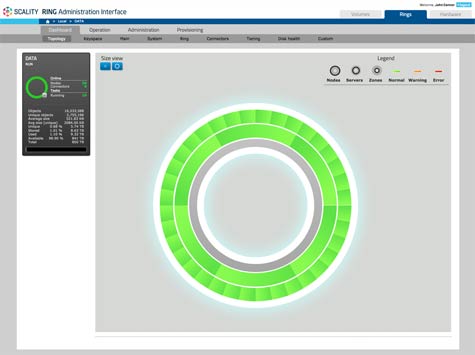
RING-6---Home

As the amount of data that needs to be managed has escalated, interest in object-based storage is rising. Most traditional file and block storage systems were never designed to scale to the level required by modern Big Data applications. Object storage systems can be made to appear to be traditional file systems to legacy applications. But for modern applications, most developers are standardizing on the S3 API to provide direct access to object storage on AWS. Scality RING, says Leung, makes it possible to run those applications across a hybrid cloud computing environment.

Arguably, the most complex part of any hybrid cloud computing environment is managing data as it moves across what is essentially a massive distributed computing environment. The simplest way to reduce the inherent data management friction in those environments is finding a way to make sure that all the storage systems involved share a common set of protocols that will make moving data in and out of those environments a whole lot simpler than it would otherwise be.

MV

Michael Vizard is a seasoned IT journalist, with nearly 30 years of experience writing and editing about enterprise IT issues. He is a contributor to publications including Programmableweb, IT Business Edge, CIOinsight and UBM Tech. He formerly was editorial director for Ziff-Davis Enterprise, where he launched the company’s custom content division, and has also served as editor in chief for CRN and InfoWorld. He also has held editorial positions at PC Week, Computerworld and Digital Review.

Recommended for you...

Top ETL Tools 2022
Collins Ayuya
Jul 14, 2022
Snowflake vs. Databricks: Big Data Platform Comparison
Surajdeep Singh
Jul 14, 2022
Identify Where Your Information Is Vulnerable Using Data Flow Diagrams
Jillian Koskie
Jun 22, 2022
IT Business Edge Logo

The go-to resource for IT professionals from all corners of the tech world looking for cutting edge technology solutions that solve their unique business challenges. We aim to help these professionals grow their knowledge base and authority in their field with the top news and trends in the technology space.

Property of TechnologyAdvice. © 2025 TechnologyAdvice. All Rights Reserved

Advertiser Disclosure: Some of the products that appear on this site are from companies from which TechnologyAdvice receives compensation. This compensation may impact how and where products appear on this site including, for example, the order in which they appear. TechnologyAdvice does not include all companies or all types of products available in the marketplace.