While small-to-medium sized businesses may not require the complex cooling systems typical of enterprise data centers, choosing the right cooling solution is still a critical component to ensuring IT services are delivered efficiently and with minimal downtime. Determining and implementing a correctly sized air conditioning system is a great way for SMBs to increase energy efficiency and avoid wasted electricity associated with unnecessary cooling. However, some IT managers may be unsure of where to begin. This slideshow outlines a number of steps, identified by Schneider Electric, that SMBs can take to ensure sustainability while also satisfying ASHRAE guidelines.
Click through for steps, identified by Schneider Electric, that SMBs can take to ensure cooling sustainability while also satisfying ASHRAE guidelines.
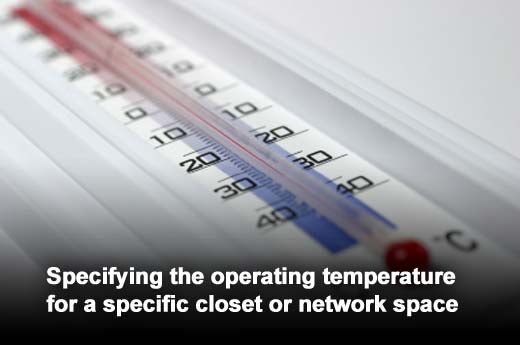
To determine the cooling solution that’s right for the specific wiring closet, you need to first determine ideal temperature settings for the environment. The final design must consider all variables that affect cooling.
First, specify the temperature the specific closet or network space should operate at. The typical recommended operating temperatures from IT equipment vendors are between 70°F (21°C) and 75°F (24°C). The maximum recommended temperature for active IT equipment in a wiring closet is usually 104°F (40°C).
Note: 104°F (40°C) is the maximum temperature at which the vendor is able to guarantee performance and reliability for the stated warranty period. It is important to understand that although the maximum published operating temperature is acceptable per the manufacturer, operating at that temperature will not generally provide the same level of availability or longevity as operating at lower temperatures can.
The American Society for Heating, Refrigeration and Air-Condition Engineers (ASHRAE) develops general temperature guidelines under which IT equipment should operate. Manufacturers are increasingly producing equipment that is far less vulnerable to temperature and humidity. In response, the ASHRAE TC 9.9 standard expands the recommended operating temperature range to 68-77°F (20-25°C). The allowable operating temperature range is 59-90°F (15-32°C).

There are five basic ways to cool an office or IT closet. They are:
- Conduction: Heat can flow through the walls of the space
- Passive ventilation: Heat can flow into cooler air via a vent or grille, without an air moving device, such as a fan
- Fan-assisted ventilation: Heat can flow into cooler air via a vent or grille that has an air moving device
- Comfort cooling: Heat can be removed by a building’s comfort cooling system
- Dedicated cooling: Heat can be removed by a dedicated air conditioner
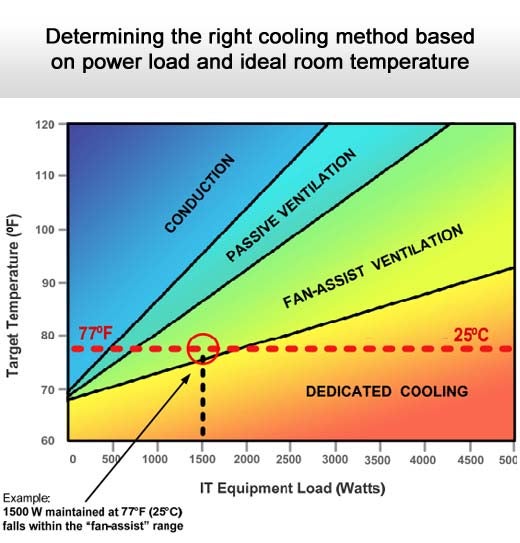
This chart can help determine the right cooling method for your IT infrastructure based on IT equipment load (in watts) and target temperature.
Every kilowatt of heat used by the IT equipment creates a kilowatt of heat power, which must be removed.
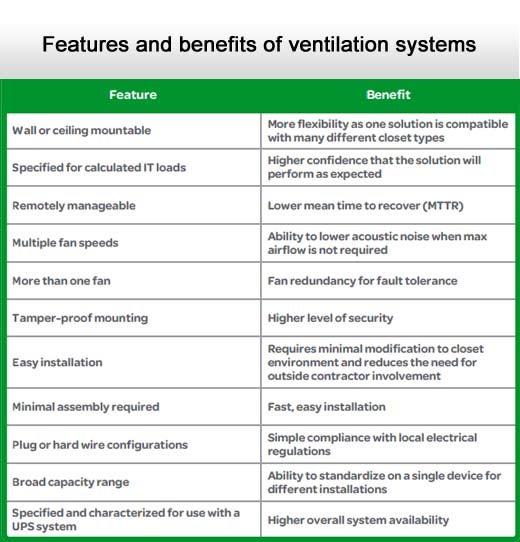
Ventilation is the most effective and practical cooling strategy for most IT closets, whether implemented with the assistance of fans or as a passive cooling technique. The emergence of ventilation systems specifically designed and characterized for IT closets simplifies the selection process and allows for implementation of standardized closet cooling solutions across the board.
However, when the power level for critical closets is over 2000 watts (4500 watts for non-critical closets), or the ambient air outside the closet is hot, uncontrolled, or contaminated, dedicated air conditioning should be used as a cooling method. The use of existing comfort air conditioning systems for closet cooling is not recommended because it will almost always result in wide closet temperature fluctuations.