Our partners at Info~Tech Research Group have provided this overview of the key issues facing IT leaders as they consider build-outs or upgrades of their data centers. As you read through this report, you will also find links to free downloads of numerous Info~Tech tools and research notes to support you in your decision-making process. […]
Our partners at Info~Tech Research Group have provided this overview of the key issues facing IT leaders as they consider build-outs or upgrades of their data centers. As you read through this report, you will also find links to free downloads of numerous Info~Tech tools and research notes to support you in your decision-making process.
|
|
 |
|

Our partners at Info~Tech Research Group have provided this
overview of the key issues facing IT leaders as they consider build-outs
or upgrades of their data centers. As you read through this report, you will
also find links to free downloads of numerous Info~Tech tools and
research notes to support you in your decision-making process.
|
|
|
 |
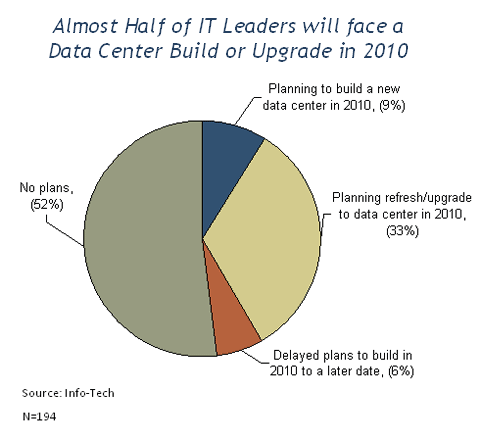
- – 42% of IT leaders will face a data center build or upgrade in 2010 – one of the most expensive and complex IT projects, it can cost up to $1.6 M for a 1000 square foot data center.
- – Each data center project is unique and should have its own detailed budget. Planning up front and establishing a clear project scope will minimize expensive changes in later project stages.
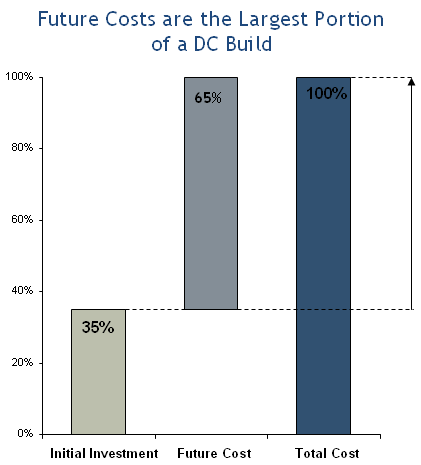
- – Industry benchmarks are not always accurate – the absence of a budget risks cost overruns by 22%. Hidden costs for landscaping, permits, and security can increase capital investments. Ongoing operating expenses must also be budgeted, as they represent 65% of the total costs associated with building a data center.
- – Accurate estimates of facility requirements are a critical input to the project’s budget.
- – Power and cooling supply requires careful estimation to accommodate future growth yet avoid unwarranted costs.
- – Fire protection is mandated by law and comes with real consequences as it can impact life safety.
- – Site selection should identify any potential issues that may lead to additional construction costs, especially in an existing building.
- – Hire a specialized general contractor and avoid those who build office spaces only. Data centers have more stringent, unique code requirements. Use specialized talent to avoid costly retrofit later.
|
Many IT organizations face a
data center build but fail to recognize the
design and engineering complexities.
|
|
 |
|
Data Center facilities require industrial design and engineering
- – Data centers are getting bigger and more complex.
- – Despite the availability of consolidation technologies, organizations Info-Tech surveyed were two times more likely to increase the size of their data center than decrease it.
- – Internal expertise is most often lacking to undertake the build.
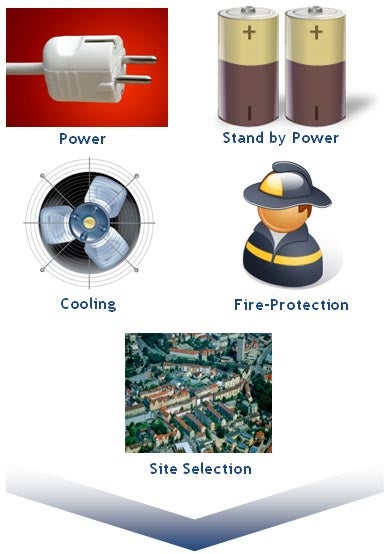
- – Data center facilities require specific industrial design and engineering requirements to meet the needs for fire-protection, power provisioning, stand-by power, cooling, physical security, and layout.

|
Careful analysis of five key design
elements done internally now will yield better
cost and build outcomes later.
|
|
 |
|
Analyze These 5 Now
|
|

|
|
To Yield Better Cost & Outcomes Later
|
- – Analyze these five factors before engaging outside consultants and contractors to correctly align the facility costs and capacity with enterprise needs.
- – Data Center construction projects executed without these five design activities, before awarding contracts, demonstrate a higher likelihood of cost overruns, overcapacity, and problems.
|
Establish clear project scope to minimize
expensive changes in later project stages.
|
|
 |
|
Complete this project charter before the project commences to identify a clear and defined scope, decision rights, potential risks, and receive executive sponsorship.
The “Data Center Build Project Charter Template” will help you:
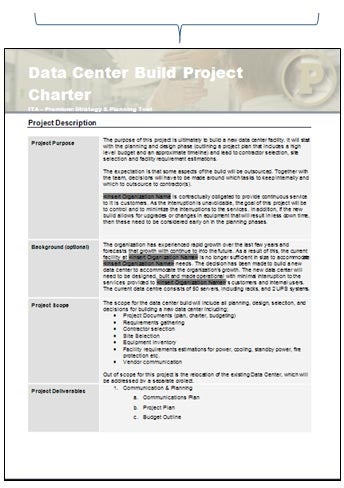
- – Understand just how big a project you are building.
- – Provide input into a build vs. buy decision.
- – Provide a project approval for business leaders to sign off on.
- – Reduce external costs of the project overall.
|
65% of costs occur after the data center is
built — get a handle on all costs before the build.
|
|
 |
- – On average, a 1000 square foot data center costs $1.6 M.
- – Each project is unique and should have its own detailed budget; create a detailed list of expected expenses for an accurate budget.
- – Consider ongoing costs in your initial budget calculations, as they make up the bulk of the total costs associated with building a data center.
- – Some major ongoing operating expenses include:
- – Building leases
- – Fire suppression systems
- – Mechanical systems for electrical distribution, and in-room cooling
|
Info-Tech research shows that data centers
cost between $400 and $700 per square foot.
Lower than industry conventions.
|
|
 |
- – Using conventional industry standards can lead to over-estimating the build budget; Info-Tech’s research shows actual costs are 22% less.
- – Organizations that rely on the industry standard of $600 to $900 per square foot when creating their budgets run the risk of over budgeting and over spending.
- – As a result, general benchmarks should not be used for a data center build.
- – Organizations should complete their own detailed investment and expenses to accurately budget for their builds.
|
For a more accurate and inclusive cost estimate
use Info-Tech’s budgeting tool.
|
|
 |
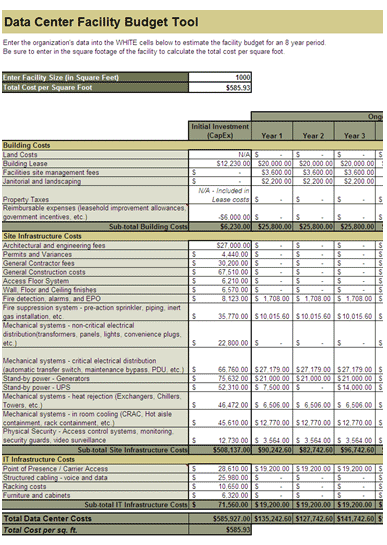
- – The ITA Premium, “Data Center Facility Budget Tool” enables the organization to account for all costs in order to arrive at an accurate estimate.
- – Accounts for hidden costs, such as janitorial expenses, landscaping, permits, and physical security.
- – Provides a complete example for a 1000 sq ft facility that you can tailor to suit your situation.
- – Factors all necessary renovations, repairs, and upgrades related to purchasing an existing data center into the final cost.
- – Even if you are planning on renovating an existing data center, you can still use the tool to determine ongoing operational costs.
|
Power estimates should accommodate
facility and equipment requirements.
|
|
 |
|
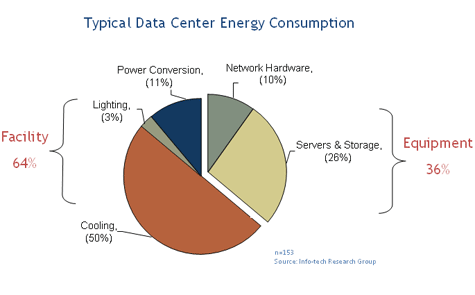
Do not focus solely on the IT equipment housed in the data center.
|
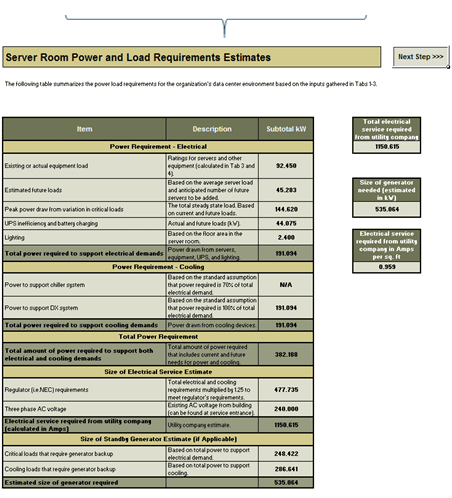
Leverage the “Data Center Power
and Cooling Requirements Calculator”
to ensure budget accuracy.
|
|
 |
|
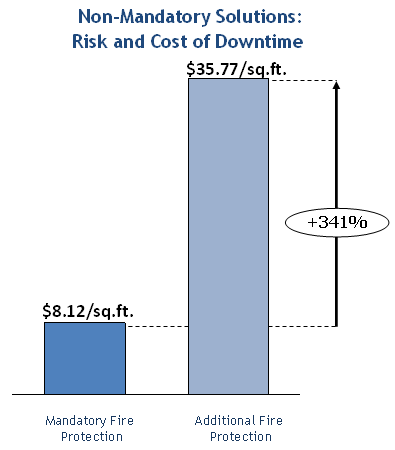
Fire protection is not solely about IT assets;
additional protection must be evaluated
to avoid unnecessary costs.
|
|
 |
- – The number one consideration when evaluating fire protection options is life safety in the data center. It is mandated by law and non-negotiable.
- – While clean agents can be very effective in suppressing fire and protecting property, they are also expensive to install and maintain and, may be toxic.
- – Refer to the ITA Premium research note, “Fire Protection: Only YOU Can Prevent Data Center Fires” for more detailed guidance.
- – Under NFPA 75 a data center must have a sprinkler system, detection and alarm systems, emergency power-off, and portable fire extinguishers.
|
Existing building sites often lead to
additional construction costs. Site evaluation
should identify any potential issues.
|
|
 |
|
The selected site must be evaluated before the data center budget can be finalized.
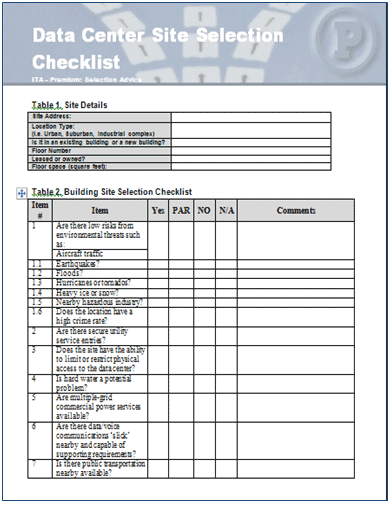
- – Use the free “Data Center Site Selection Checklist” to target issues that will lead to cost overruns of safety/security concerns.
- – External environment, including physical hazards.
- – Internal checkpoints (power, cooling, etc.) in existing facilities.
- – Physical building attributes such as loading docks and water lines.
- – Security checkpoints for the protection of systems and staff.
- – Access control systems to prevent intruders.
- – RFacility layout must be planned before construction starts.
- – Data centers house more than just servers. Provide space for all equipment and to serve all functions.
- – Refer to the research note, “Planning for Data Center Physical Layout and Support Center Space” for more detailed guidance.
|
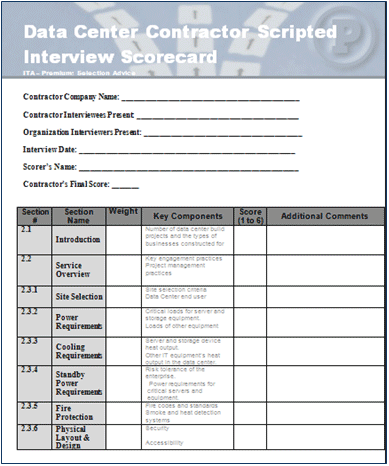
A common scorecard makes the contractor
selection process transparent.
|
|
 |
- – Each contractor should be evaluated based on a standard scoring method to ensure accuracy and fairness.
- – Use the “Data Center Contractor Scripted Interview Scorecard” to show senior management why a particular contractor is the best fit and ensure you account for the following important aspects:
- – Data center build experience of similar size and scale
- – Project management practices
- – Site selection processes
- – End user requirements processes
- – System execution and management practices
- – Support during and after the build
|