

Cloud Forecast: Where It’s Been and Where It’s Heading

The top two reasons that IT organizations embrace cloud computing services come down to cost and agility. But as cloud computing matures, it’s also becoming apparent that some IT services can be delivered much more simply in the cloud than on premises.
To illustrate that point, Snowflake Computing today revealed that it has added new capabilities to its Elastic Data Warehouse service that make it simpler to administer and protect data in a relational database that was designed from the ground up to support a data warehouse deployed as a cloud service.
Jon Bock, vice president of products for Snowflake Computing, says Elastic Data Warehouse now makes it possible to automatically recover data at any point in time without having to rely on snapshots that then need to be recovered from a storage system. Instead, Bock says IT organizations can now make use of a “time machine” capability to roll the database back to any point in time required.
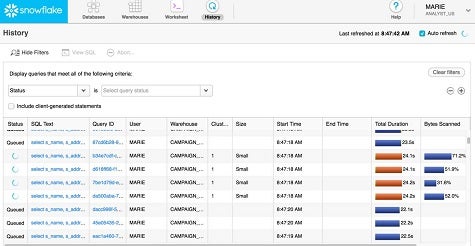
Bock says the multi-cluster capabilities of the underlying relational database have been extended to allow it to automatically scale up to meet additional concurrency requirements on demand. It would take a database administrator (DBA) several hours to accomplish the same task using a traditional relational database running on premises, says Bock.
While Snowflake Computing was an early pioneer of delivering a relational database as a service, both Oracle and Microsoft have since launched similar services. In each case, the core argument for employing a database-as-a-service (DBaaS) is not only the method of delivery, but also the fact that all the underlying management tasks are handled by the cloud service provider rather than a DBA who has to be hired by the IT organization. In the case of the Elastic Data Warehouse, Bock notes that many of the tasks associated with traditional data management, such as distributing data and creating metadata around that data, have now been automated.
Thus far, Bock says Snowflake Computing has signed up over 200 customers for a service that now manages petabytes of data. The degree to which IT organizations will be willing to consider alternatives to the database vendors that currently dominate the data warehouse landscape on premises will vary. But as DBaaS offerings of all types proliferate across the cloud, there will be no shortage of options.
Save