

2016 Trends: Preparing the Network for Web-Scale Demands

EMC this week made available what it describes as the first Flash storage system that leverages PCIe Gen3 and NVMe technology to deliver I/O performance that it claims can deliver latencies of 100 microseconds, throughput as high as 100 GB per second, and up to 10 million IOPS in a 5U system.
Christened the EMC DSSD D5, EMC says the Flash technology it gained by acquiring DSSD Inc. last year will drive a factor of 10 increase in application performance that no other Flash array can match.
Developed by a team lead by Andy Bechtolsheim, who in addition to founding DSSD also serves as the CDO of Arista Networks, the EMC DSSD D5 is unique in that it eliminates all the dependencies on the SCSI software stack that was originally developed for spinning disks. In its place, the EMC DSSD D5 makes use of a Flood application programming interface (API) and a key/value store architecture that allows 48 servers to share access to 100TB of usable Flash storage.
In addition to delivering the EMC DSSD D5, EMC this week revamped its VMAX All Flash arrays, which can now scale up to 4PB while natively supporting block, file, open systems and mainframes. Built around a V-Brick architecture, each V-Brick contains one VMAX engine and starts with 53TB of usable capacity that can be scaled up to 500TB in 13TB increments. Up to eight VMAX engines can be scaled out to reach 4PB of capacity. EMC also announced it is making use of a new Write Folding approach to laying data down on a solid-state drive (SSD) that improves durability while simultaneously optimizing peak performance.
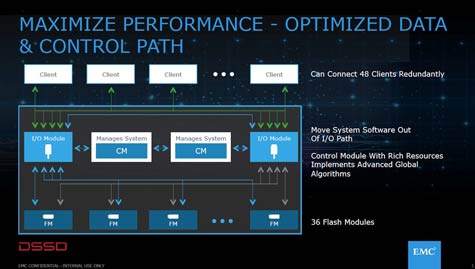
While the VMAX series continues to make use of SCSI technology, Bechtolsheim at an EMC event in New York this week made a compelling case for eliminating SCSI altogether. Within a rack, multiple EMC DSSD D5 systems can be combined to provide access to petabytes of data. In addition, Bechtolsheim says, EMC plans to double that capacity in the next 12 months and the same systems will be able to support 3D NAND Flash memory using a hot-swappable module once that new class of Flash memory becomes generally available.
Obviously, the price points and amount of capacity that IT organizations can avail themselves of using an EMC DSSD D5 system and VMAX arrays will differ substantially. But as Bechtolsheim notes, the EMC DSSD D5 is now the fastest system on the planet.