

4 Ways IT Can Better Align Itself to Fulfill Business Needs

Not too long ago, application integration was a process that needed to be planned out over a period of months. But with the rise of new classes of platform-as-a-service (PaaS) environments specifically designed for integration, many end users are now playing a much bigger role in application integration. Instead of taking on a few projects a year, many organizations are now integrating applications as rapidly as the business evolves.
Built.io developed an iPaaS offering dubbed Built.io Flow that enables end users to collaborate at any level they deem appropriate. In some instances, end users may opt to integrate applications themselves, while in other cases they may require more developer expertise.
The latest version of Built.io Flow sports a revamped user interface and adds support for a mobile application that end users can download to view and edit workflows. In addition, Built.io now provides a bot integration module for Slack, a collaboration tool that is starting to gain momentum in the enterprise.
For developers, Built.io has added support for a Real Time API Listener, which makes it simpler for events in one application or system to be shared with another application. In addition, Built.io has also announced that its enterprise gateway for connecting Built.io in the cloud to on-premise applications is now generally available.
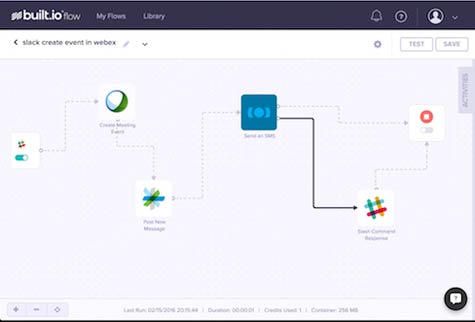
Built.io COO Matthew Baier says the biggest challenge many IT organizations face today is that for every dollar they spend on a SaaS application, they have to spend another dollar integrating it. An iPaaS environment in the cloud that is readily accessible to both end users and developers drops the cost of integrating applications by several orders of magnitude, says Baier. At present, Built.io has developed a library of over 400 connections that organizations can invoke as a service on demand.
It may take a little while for professional developers and so-called citizen integrators, formerly known as power users, to find their integration rhythm. But once they do, it’s pretty clear that the rate and pace at which applications are integrated across the enterprise will never be the same.