

Beware the Data Collectors for They Are Us: Privacy and Big Data

Moving to make it a lot simpler to incorporate anything that exposes an application programming interface (API) within a larger business process, Built.io today announced the general availability of a workflow integration service that runs in the cloud.
Built.io CTO Nishant Patel says Built.io Flow provides a graphical tool through which end users can invoke the API of any application or piece of infrastructure to create workflows at any scale they like. As part of that effort, Built.io is making available hundreds of pre-configured, out-of-the-box connectors to popular enterprise software packages, such as Salesforce, Marketo and Zendesk. In addition, for applications and systems that don’t have a well-defined set of APIs, Built.io is making available an Advanced API Builder tool.
Patel says that Built.io Flow makes use of a WebHooks programming model to create an event-driven workflow architecture that can invoke any API. On top of that architecture, Built.io has layered a graphical set of tools through which “citizen integrators” can drag and drop any application or system into a workflow process. Once the workflow is created, Triggers are used to invoke the underlying WebHooks and APIs and a Live Trigger Visualization capability allows developers to test, debug and run automated, real-time workflows.
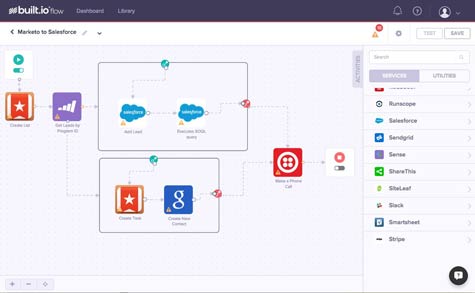
Finally, Built.io has also developed a Built.io Flow Enterprise Gateway that securely connects its service to applications and systems sitting behind a firewall.
While Built.io already makes available backend-as-a-service (BaaS) software for developers that connects applications in real time, Patel says Built.io decided to take integration via the cloud to the next logical level, which he says should not require IT organizations to write actual code.
The degree to which integration service in the cloud will replace traditional integration frameworks naturally remains to be seen. But the one thing that is for certain is that if no code has to be written to integrate applications and systems chances are the number of things that end users will want to integrate is about to exponentially increase.