
SHARE
Facebook X Pinterest WhatsApp

Pure Storage Weaves 3D TLC NAND Flash Memory into Storage Mix

5 Big Ways Big Data Is Changing the IT Network As part of an effort to push the cost per gigabyte of Flash storage down to $1.50, Pure Storage this week announced it is adding support for 3D TLC NAND flash technology in its storage arrays. Pure Storage is also making available capacity-planning software free […]

Written By
MV
Mike Vizard
Nov 19, 2015
Slide Show

5 Big Ways Big Data Is Changing the IT Network

As part of an effort to push the cost per gigabyte of Flash storage down to $1.50, Pure Storage this week announced it is adding support for 3D TLC NAND flash technology in its storage arrays.

Pure Storage is also making available capacity-planning software free of charge and analytics software that promises to alert IT organizations when there might be an issue with a component before an array actually goes down.

Matt Kixmoeller, vice president of products for Pure Storage, says 3D TLC NAND flash makes use of multiple levels within Flash storage to enable Pure Storage to deliver a FlashArray//m offering capable of storing up to 44TB. In addition, Kixmoeller notes that customers can also opt to mix and match TLC and existing MLC Flash storage in the same system to store up to 60TB per rack unit.
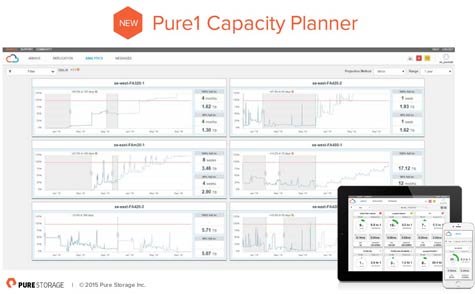
Pure-Storage-Capacity-Planner

Meanwhile, via an existing cloud management service that Pure Storage uses to remotely manage its arrays, a new Pure Storage Pure1 Global Insight service applies analytics against real-time diagnostic data gathered from thousands of arrays. Those scans then create a library of “fingerprints” to more easily identify known issues, configuration and environmental changes, and performance and capacity anomalies. The result, says Kixmoeller, is a significant reduction in the amount of down-time an organization might experience in the event of component failure or human error.

While it may not be clear yet just how much primary storage will be moving into Flash arrays, at a cost of $1.50 per gigabyte, the ability to give multiple applications access to shared Flash storage gets more compelling. The challenge now is to figure out how and when to start migrating terabytes of data that currently reside in magnetic storage systems that, at least from a primary storage perspective, are starting to look like they may be more trouble than they’re worth.

MV

Michael Vizard is a seasoned IT journalist, with nearly 30 years of experience writing and editing about enterprise IT issues. He is a contributor to publications including Programmableweb, IT Business Edge, CIOinsight and UBM Tech. He formerly was editorial director for Ziff-Davis Enterprise, where he launched the company’s custom content division, and has also served as editor in chief for CRN and InfoWorld. He also has held editorial positions at PC Week, Computerworld and Digital Review.

Recommended for you...

Unifying Data Management with Data Fabrics
Litton Power
Jun 17, 2022
Top Big Data Storage Tools 2022
Surajdeep Singh
Jun 16, 2022
8 Top Data Startups
Tom Taulli
May 20, 2022
IT Business Edge Logo

The go-to resource for IT professionals from all corners of the tech world looking for cutting edge technology solutions that solve their unique business challenges. We aim to help these professionals grow their knowledge base and authority in their field with the top news and trends in the technology space.

Property of TechnologyAdvice. © 2025 TechnologyAdvice. All Rights Reserved

Advertiser Disclosure: Some of the products that appear on this site are from companies from which TechnologyAdvice receives compensation. This compensation may impact how and where products appear on this site including, for example, the order in which they appear. TechnologyAdvice does not include all companies or all types of products available in the marketplace.