


Data centers are designed for reliability, usually at the expense of efficiency. Such waste increases capital and operational expenditures, and can result in finite resources being exhausted, thereby creating a situation where relentless growth threatens to outgrow the data center. Clemens Pfeiffer, CTO of Power Assure, Inc., a data center infrastructure and energy management solutions provider, outlines 10 steps IT and facility managers can take to improve efficiency without compromising reliability.
Click through for 10 ways to improve data center energy efficiency, as identified by Clemens Pfeiffer, CTO of Power Assure, Inc.
In a typical data center only about half of the power available is actually used by the IT equipment, with the rest going mostly to cooling. Much of that power can be reclaimed by eliminating cooling inefficiencies, upgrading the cooling system to allow for variable cooling and/or making greater use of outside air. Additional efficiency can be achieved by right-sizing the UPS and power distribution equipment.
Poor server utilization is one of the biggest sources of waste in most data centers. Virtualizing the servers can increase overall utilization from around 10 percent (typical of dedicated servers) to between 20 and 30 percent and over 50 percent with more dynamic management systems. Successful consolidation and virtualization initiatives can also reclaim a considerable amount of rack space and stranded power.
A best practice today is to adopt a hot/cold aisle configuration and increase the cold aisle inlet temperatures to 80.6°F (27°C) as recommended by the American Society of Heating, Refrigerating and Air-Conditioning Engineers (ASHRAE). But hot/cold aisle configurations can create hot spots that waste power and cause outages. Balancing the equipment, and then calibrating and continuously monitoring the cold aisle temperature maximizes cooling efficiency and minimizes problems.

Even the best virtualized and recently refreshed server configurations waste power during periods of low application demand. Total server power consumption can be reduced by up to 50 percent by matching online capacity to actual load in real-time. Runbooks can be used to automate the steps involved in power-capping and/or de/reactivating servers, whether on a predetermined schedule or in response to unanticipated events.
The lack of complete correlation between facility and IT emergency procedures can unnecessarily cause and/or extend application outages. Fully correlating and automating these procedures minimizes the impact outages have, and also reduces the UPS/generator load during an outage, thereby extending the availability of power.
Older equipment often uses power inefficiently, and newer servers with a high idle/peak swing (above 50 percent) can overload circuits more frequently when incorrectly allocated and aggregated. Using the PAR4 methodology specified in the Underwriters Laboratories UL2640 standard to determine actual power consumption makes it possible to maximize server capacity while eliminating the risk of overloading circuits under peak utilization.

While the use of an automatic transfer switch between the grid and the generator is a common configuration, an AC (Alternate Current) or DC (Direct Current) distribution bus is far more efficient and just as effective during a power outage. The bus configuration seamlessly integrates all sources of power, including any on-site fuel cells and solar/wind energy, and enables generator maintenance cycles to be put to good use.
Many organizations operate redundant data centers to satisfy business continuity needs, but very few take full advantage of this powerful configuration. Having multiple, strategically-located data centers enables loads to be shifted to where power is currently the most stable and the least expensive. Because power is invariably most abundant and least expensive at night, such a follow the moon strategy can result in considerable savings.
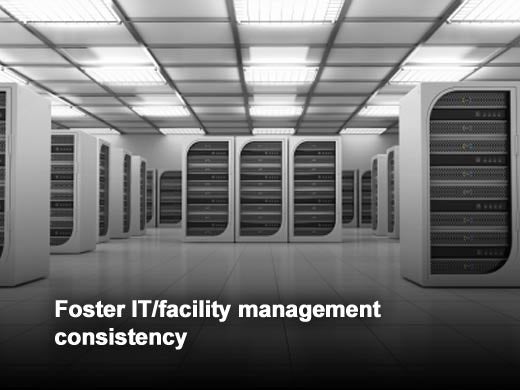
Maximizing data center efficiency (which also helps minimize capital and operational expenditures) will require an unprecedented level of cooperation between IT and facility managers. At a minimum, all aspects of monitoring and managing the data center infrastructure should become both consistent and pervasive across the IT and facilities organizations. Achieving the best results requires a holistic view of power consumption, environmental conditions and resource utilization together with utility grid and weather conditions. Such transparency can help delay new data center construction and expensive equipment purchases and should be on the must have list for every CFO.
Electricity is expensive, and data centers will continue to consume an ever-increasing amount of it. The AC or DC distribution bus configuration better prepares the organization to reap financial rewards by participating in the smart grids ancillary energy markets and demand response events, or through distributed generation via net metering with a microgrid powered by sources of renewable energy.