

Debunking the Top Data Center Myths

While there’s certainly a lot of interest in containers within the Linux community, deploying them in a production environment is still a major challenge. As a lightweight alternative to virtual machines, containers make more efficient use of IT infrastructure that is being used to run more application workloads than ever.
This week, ClusterHQ launched Flocker 0.1, an open source volume and container manager for Docker environments, which are starting to be spun up on multiple distributions of Linux.
Rob Haswell, vice president of engineering for ClusterHQ, says Flocker is designed to make it feasible to actually deploy Docker containers in production environments by providing a mechanism to manage service requests across a distributed environment. By providing an orchestration and management framework for Docker, Haswell says it now becomes easier, for example, to move Docker containers around a distributed environment because Flocker keeps track of which containers are running on different nodes. That approach, says Haswell, will allow IT organizations to take a data-centric approach to managing Docker containers that does not lock them into any particular platform.
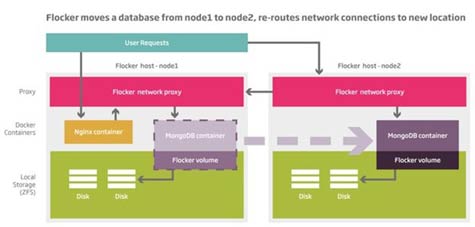
Flocker makes use of YAML files to manage the Docker environment. Each application configuration defines which Docker images make up an application. A deployment configuration describes where containers should be deployed on a cluster. IT administrators can specify which volumes a container gets to use and, if the container moves, those volumes will be copied over as well.
It’s too early to say what impact Docker containers will ultimately have on the data center. Right now, IT organizations are mostly still testing the viability of containers. In addition, management standards for Docker are still being defined. But it’s almost certain that containers are going to be deployed in support of specific classes of application workloads alongside virtual machines. From an operations perspective, that means IT organizations will need to learn how to manage both containers and virtual machines side by side in production environments.