

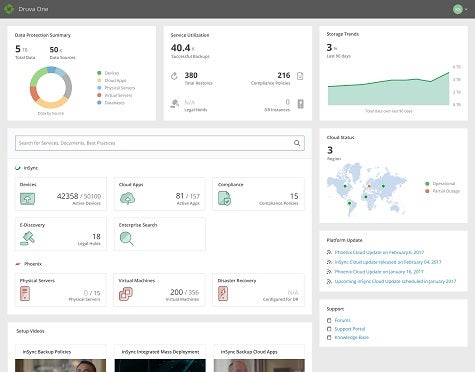
The rise of cloud computing creates an opportunity to rethink how data protection gets implemented and managed on an end-to-end basis. Instead of thinking about backup and recovery, archiving and business continuity in isolation, the cloud creates an opportunity to unify all those processes. Druva is enabling IT organizations to unify all those processes using a unified data model and common control plane provided via the launch today of Druva Cloud Platform.
Dave Packer, vice president of product marketing for Druva, says providing a common control plane based on a new Druva Predictive Storage Engine for managing multiple types of data management tasks, including analytics and elastic search, creates a major opportunity to reduce total cost of ownership (TCO) at a time when the amount of data that needs to be managed is increasing exponentially.
“A lot of organizations are suffering from tool overload,” says Packer. “There are too many vendors involved.”
The Druva Storage engine, says Packer, not only leverages time-indexed metadata software and modern REST application programming interfaces (APIs), it is infused with heuristics and machine learning algorithms to, for example, optimize backup windows and identify the organization’s most critical data.
Packer says the shift to the cloud reflects how data protection is rapidly evolving. A survey of 443 IT professionals using VMware software published by Druva today finds that 82 percent of those surveyed cited disaster recovery as a critical reason to move to the cloud, with more than half of the respondents (54 percent) saying they want a single, central solution for protecting data in either a multi-cloud or hybrid cloud environment. A full 63 percent of those respondents also said they are considering adoption of additional hypervisors beyond VMware.
These days, there is no shortage of options when it comes to moving data protection into the cloud. But as IT organizations consider those options, they would be well advised to starting thinking about data protection in the cloud as something that goes well beyond simple backup and recovery.