

5 Lessons to Brush Up Your Cloud Security Knowledge

Taking a significant step toward making it simpler to deploy multiple types of application environments on top of a common set of IT infrastructure, VMware at the DockerCon Europe 2015 conference today fulfilled a pledge to open source a Photon Controller project through which organizations can invoke a common set of loosely coupled components and services.
VMware as part of that effort is making available as open source code a new CloudStore framework, dubbed Xeon, that via agent software provides a single repository through which organizations can now keep track of all objects in the enterprise, including containers, clusters, virtual machines, disks, networks and physical hosts, that are connected to an implementation of Photon Controller via a REST application programming interface (API). CloudStore itself is built on top of open source Lucene search engine software.
Other key components of the Photon Controller, which can support everything from Kubernetes orchestration software for containers to platform-as-a-service (PaaS) environments such as Cloud Foundry, include a distributed scheduler and a “housekeeper” module that over time cleans up long-running operations.
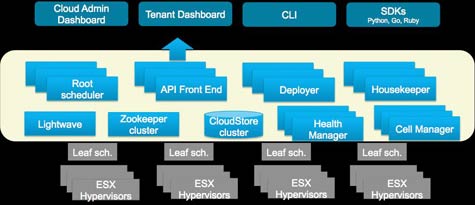
Mike Paiko, director of product marketing for cloud-native apps at VMware, says Photon Controller is a critical element of how VMware envisions how both software-defined networking (SDNs) in particular and software-defined data centers (SDDCs) will evolve going forward. In fact, Paiko says that at this juncture, the biggest challenge with making that shift has less to do with the technology itself than it does with putting the processes and people in place to make the transition.
While it’s clear that just about every organization to one degree or another will soon embrace SDDC as a concept, how they will each get there will involve many different paths. Irrespective of the path chosen, VMware is making it clear that it is committed to providing a set of both north- and south-bound interfaces through which IT organizations can manage multiple types of application environments running on top of any set of IT infrastructure they choose.