SHARE
Facebook X Pinterest WhatsApp

Silver Peak Advances Thin Branch Computing at Network Edge

A fierce battle is under way for control of the edge of the network as providers of software-defined wide area networks move to shunt aside traditional routers, wide area network (WAN) optimization appliances and firewalls in favor of a more integrated platform approach to providing those services. Silver Peak today is trying to advance that […]

Written By
MV
Mike Vizard
Mar 28, 2017

A fierce battle is under way for control of the edge of the network as providers of software-defined wide area networks move to shunt aside traditional routers, wide area network (WAN) optimization appliances and firewalls in favor of a more integrated platform approach to providing those services.

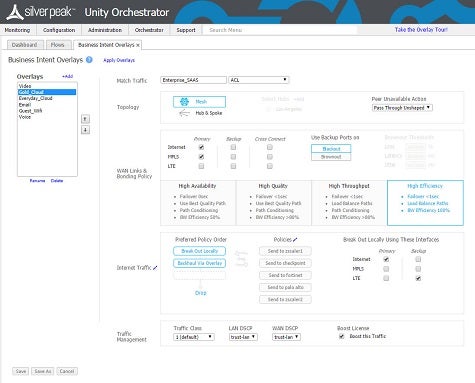
Silver Peak today is trying to advance that argument with the addition of enhancements to its Unity EdgeConnect SD-WAN that adds support for BGP routing as well as a stateful firewall.

In addition, Silver Peak is adding a First-packet IQ capability that is based on the first packet received automatically identifying more than 10,000 applications and 300 million web domains. Damon Ennis, senior vice president of products for Silver Peak, says that capability will prove critical in terms of being able to route traffic coming off the edge of the network either back to a cloud service or a local data center or a cloud service without having to backhaul every packet to a central location.

Ennis says Unity EdgeConnect is a leading example of a shift being made to “Thin Branch” computing at the edge of the network. Instead of deploying separate routers, firewalls and other appliances, platforms such as Unity EdgeConnect create the opportunity to consolidate all those functions, says Ennis.

In general, IT organizations are looking to SD-WANs to employ internet connections in place of more expensive MPLS lines for certain classes of applications.

“Internet connections are one-tenth the cost of MPLS,” says Ennis.
EdgeConnect

But even though MPLS lines may be considerably more expensive than a standard internet connection, they do provide much higher levels of performance and security. The challenge facing IT organizations now is identifying which applications can be serviced by a lower-cost internet connection versus an MPLS line that should be reserved for a smaller number of latency-sensitive applications.

MV

Michael Vizard is a seasoned IT journalist, with nearly 30 years of experience writing and editing about enterprise IT issues. He is a contributor to publications including Programmableweb, IT Business Edge, CIOinsight and UBM Tech. He formerly was editorial director for Ziff-Davis Enterprise, where he launched the company’s custom content division, and has also served as editor in chief for CRN and InfoWorld. He also has held editorial positions at PC Week, Computerworld and Digital Review.

Recommended for you...

5G and Industrial Automation: Practical Use Cases
Kashyap Vyas
Apr 22, 2022
Understanding the Relationship Between 5G and Edge Computing
Collins Ayuya
Apr 19, 2022
Building a Private 5G Network for Your Business 
Kihara Kimachia
Apr 18, 2022
IT Business Edge Logo

The go-to resource for IT professionals from all corners of the tech world looking for cutting edge technology solutions that solve their unique business challenges. We aim to help these professionals grow their knowledge base and authority in their field with the top news and trends in the technology space.

Property of TechnologyAdvice. © 2025 TechnologyAdvice. All Rights Reserved

Advertiser Disclosure: Some of the products that appear on this site are from companies from which TechnologyAdvice receives compensation. This compensation may impact how and where products appear on this site including, for example, the order in which they appear. TechnologyAdvice does not include all companies or all types of products available in the marketplace.