SHARE
Facebook X Pinterest WhatsApp

Juniper Networks Applies Node Slicing to Create Virtual Networks

In a move that borrows a page from the server virtualization playbook, Juniper Networks today unveiled a node-slicing capability to its router software that makes it possible for IT organizations to virtualize network services. Donyel Jones-Williams, director of service provider portfolio marketing for Juniper Networks, says that as part of a Cloud-Grade Networking portfolio of […]

Written By
MV
Mike Vizard
Jun 20, 2017

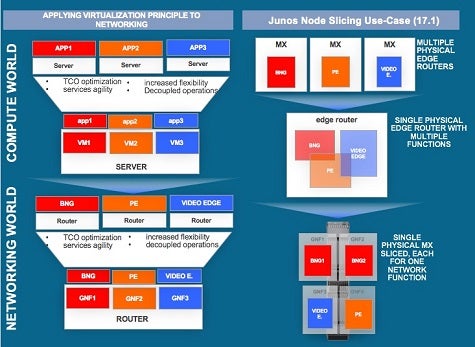
In a move that borrows a page from the server virtualization playbook, Juniper Networks today unveiled a node-slicing capability to its router software that makes it possible for IT organizations to virtualize network services.

Donyel Jones-Williams, director of service provider portfolio marketing for Juniper Networks, says that as part of a Cloud-Grade Networking portfolio of networking equipment and services, Juniper Networks is also moving to adopt a single router chassis through which multiple variations aimed at different networking scenarios will be offered.

In addition, Juniper Networks announced it is adding support for Source Packet Routing in Networking (SPRING) to its SDN along with a new real-time stream telemetry capability enabled by a Junos Telemetry Interface (JTI). That latter capability can be employed to provide real-time traffic visualization, trending and optimizing via a single click of a button.

In general, Jones-Williams says, Juniper Networks is moving to make networks more responsive to rapidly changing demands for network bandwidth. To achieve that goal, JunOS software now includes a JunOS Node Slicing capability that allows multiple network services to share the same network underlay while maintaining isolation of network services.

“The cloud made computing elastic,” says Jones-Williams. “We’re trying to bring that same level of agility to the network.”
Juniperslicing

The degree to which IT organizations can or want to enable multiple network services to share the same networking infrastructure remains to be seen. But there is a need to be able to manage enterprise networks at much higher levels of abstraction. After all, it shouldn’t take two weeks or more to provision a network service when the virtual machine that invokes it can be spun in less than two minutes.

MV

Michael Vizard is a seasoned IT journalist, with nearly 30 years of experience writing and editing about enterprise IT issues. He is a contributor to publications including Programmableweb, IT Business Edge, CIOinsight and UBM Tech. He formerly was editorial director for Ziff-Davis Enterprise, where he launched the company’s custom content division, and has also served as editor in chief for CRN and InfoWorld. He also has held editorial positions at PC Week, Computerworld and Digital Review.

Recommended for you...

5G and Industrial Automation: Practical Use Cases
Kashyap Vyas
Apr 22, 2022
Understanding the Relationship Between 5G and Edge Computing
Collins Ayuya
Apr 19, 2022
Building a Private 5G Network for Your Business 
Kihara Kimachia
Apr 18, 2022
IT Business Edge Logo

The go-to resource for IT professionals from all corners of the tech world looking for cutting edge technology solutions that solve their unique business challenges. We aim to help these professionals grow their knowledge base and authority in their field with the top news and trends in the technology space.

Property of TechnologyAdvice. © 2025 TechnologyAdvice. All Rights Reserved

Advertiser Disclosure: Some of the products that appear on this site are from companies from which TechnologyAdvice receives compensation. This compensation may impact how and where products appear on this site including, for example, the order in which they appear. TechnologyAdvice does not include all companies or all types of products available in the marketplace.