
Nothing puts a spotlight on the need to manage IT as a service than cloud computing. The trouble is figuring out how to manage the delivery of IT services that are dependent on shared IT infrastructure.
IBM and F5 Networks are taking a crack at helping IT organizations solve this issue with the release today of a new reference architecture at the IBM Pulse 2011 conference that provides a set of best practices for integrating application delivery controllers (ADC) with Tivoli systems management software from IBM.
According to Ron Carovano, business development manager for F5 Networks, the two companies have collaborated on a set of application programming interfaces (APIs) that integrate a variety of devices from F5 Networks with message bus, monitoring and orchestration software from IBM.
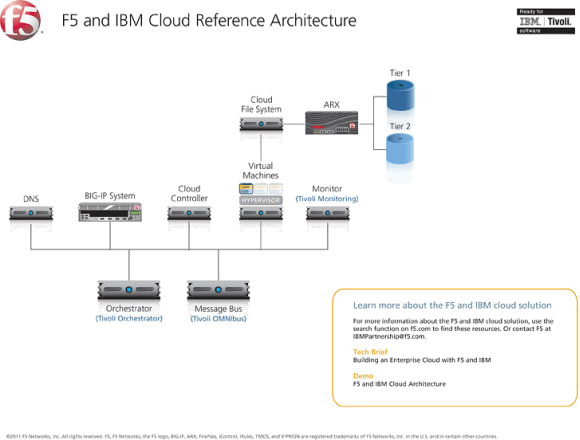
The end goal is to create a reference architecture that promises to make it easier for an IT organization to meet the requirements of a service-level agreement (SLA) in the age of the cloud. The real challenge, says Carovano, is that many application owners are still dubious of cloud computing and virtualization technologies when it comes to mission-critical applications. IT organizations need to be able to deploy a cloud computing framework that can guarantee the service levels associated with any given application, while at the same time being able to show application owners proof positive that all service-level commitments are being met.
As cloud computing evolves, it’s pretty clear that ADC technologies are going to play a critical role in terms of managing the overall cloud computing environment. As such, IT organizations should expect to see a lot more integration between ADC platforms and any number of systems management tools.
In the meantime, IT organizations need to realize that application owners are not going to embrace shared IT infrastructure simply because it lowers the cost of IT infrastructure. They are going to want SLAs with enough teeth in them to guarantee that performance metrics are not being compromised in the name of reducing the hardware budget that, in the grand scheme of things, is not the most expensive element of the overall IT value equation.