


Business process management (BPM) delivers significant benefits to organizations, but some organizations have faced many problems due to wrong turns along the way, according to Gartner, Inc. Gartner analysts have identified five BPM threats BPI (business process improvement) leaders need to be mindful of as organizations progress on their BPM initiatives.
“Considerable attention has been paid to the value of BPM and the dramatic transformation it can bring to an organization, but undertaking BPM isn’t easy and BPI leaders and practitioners often stumble along the journey,” said John Dixon, research director at Gartner. “BPM can be fraught with challenges due to the scale and breadth of skills, attributes and tools needed to be successful. BPM also presents innumerable challenges in areas such as organizational change, measurement systems, communications, business analysis, improvement methodologies and vendor selection.”
With this in mind, Gartner has compiled five BPM pitfalls to avoid.

Click through for five BPM pitfalls businesses should avoid, as identified by Gartner.

With this pitfall, the BPM team may well have delivered some value to the organization, but if it did, it failed to keep a record of these achievements, or to routinely communicate them to those that matter. All BPM projects should start with an understanding of how success (outcomes) will be measured. It is vital to understand what the team is trying to improve (with a baseline measurement) and the corresponding improvement (metric). This metric must be communicated to the business, to clearly articulate the benefits delivered. The key is to learn the language of the organization and to use that language to communicate success.

Deploying a cutting-edge business process management suite (BPMS) will solve nothing unless the organization also applies BPM as a discipline. BPM is not about technology. Because it fundamentally changes how people work, BPM is about change. The problem with relying solely on input from one subject matter expert, or group of managers, is that the process documented will reflect only what the expert or managers “think it should be.” This “offline” analysis misses one of the greatest opportunities for improvement: mapping the real process.

BPM activities must be based on facts and data, rather than reactions to those who shout the loudest. When starting a BPM initiative, it is good practice to allot a period of time to set up and gather metrics before process improvement work occurs. This period should be agreed to upfront, with the BPM steering committee or project sponsors, to properly set expectations.

A BPM team must build its capabilities, but this effort needs to be balanced with a degree of realism: the organization wants to see some return on its investment, often relatively quickly. Effort must be made to deliver benefits — even if they are relatively small at first — and to communicate them to the business so it can see some return on investment and feel positive about maintaining funding.
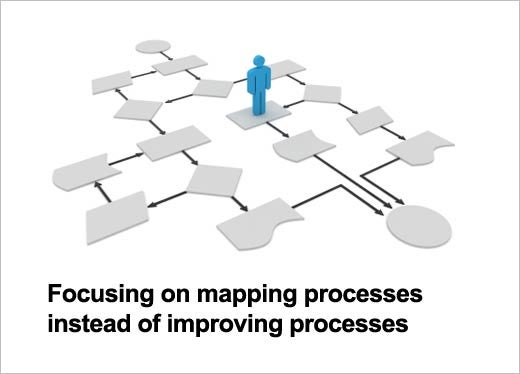
BPM teams can get lost in mapping processes, acting under the assumption that this mapping activity amounts to “doing BPM.” However, if these process maps are not used as a tool for bringing about real business improvements — or if such productive use cannot be demonstrated — they have no inherent value. BPM teams need to track and communicate the business value delivered.