


Videoconferencing can help businesses reduce operating costs, improve their decision making capabilities and increase their customer contact. Yet, just half of businesses use videoconferencing today.
In November and December 2010, CDW surveyed IT and telecommunications managers to understand videoconferencing adoption, examine key drivers and identify implementation challenges. Importantly, CDW investigated if and how businesses are measuring their videoconferencing success and their return on investment (ROI) to date.
According to the report, medium and large businesses most commonly deploy peer-to-peer conferencing and multisite meeting rooms. That said, respondents indicated increasing interest in immersive telepresence systems.
The report also found that businesses need a better understanding of the costs and benefits associated with videoconferencing, and, critically, they need a concrete plan to track these metrics. As it stands today, just slightly more than half of medium and large businesses who use videoconferencing are tracking their ROI. However, many organizations have identified ways to track these savings and communicate the value that videoconferencing offers.
This slideshow highlights the findings from the CDW videoconferencing straw poll.

Click through for results from a videoconferencing straw poll conducted by CDW.
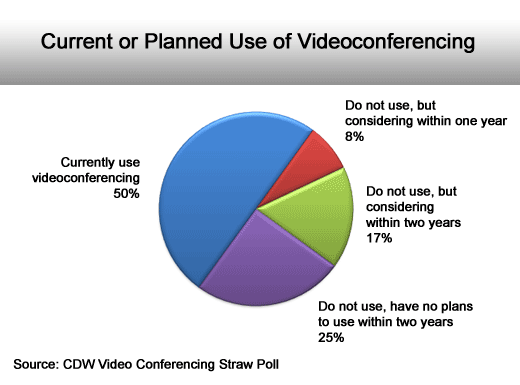
Half of medium and large businesses use video conferencing today; another quarter plan to implement the technology within the next two years.
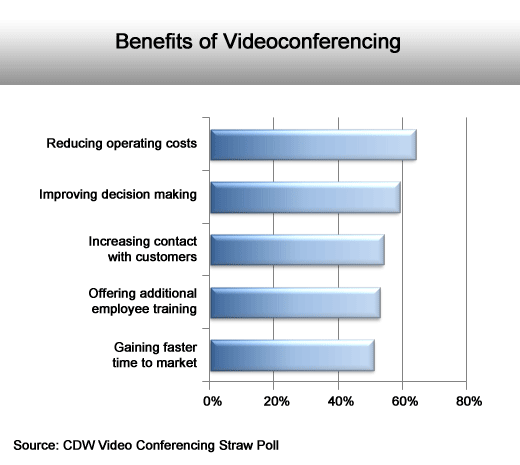
Businesses report that video conferencing provides significant value, especially as they seek to enhance customer and employee experiences. Most businesses say they use video conferencing to collaborate with remote employees and distant offices, reduce (or eliminate) travel time and costs and collaborate with external customers, partners and suppliers.

Desktop (peer-to-peer) video conferencing is the most popular video conferencing technology, although nearly half of medium and large businesses say they plan to pursue immersive telepresence within the next two years.

Businesses report that the top implementation barrier is the inability to justify the investment. Yet, many (half) of medium and large businesses are not placing high value on demonstrating ROI, and lose the opportunity to justify the investment. Just 50 percent of respondents said demonstrating hard (dollar) ROI is very important and 51 percent said demonstrating soft (productivity) ROI is very important.

Just slightly more than half of medium and large businesses currently track ROI – 56 percent track hard (dollar) ROI and 58 percent track soft (productivity) ROI. Of the medium and large businesses that track hard ROI, the majority are looking at dollars saved from trips avoided. Nearly half of medium and large businesses that track soft ROI are looking at employee productivity.

To make the most of their investment, and understanding that the IT infrastructure has to support the technology or risk alienating end users with a bad experience, most medium and large businesses that have implemented videoconferencing conducted network assessments, and many leveraged managed services for their solution:
- Sixty-nine percent of businesses that implemented videoconferencing completed a network assessment to ensure that IT could support videoconferencing.
- Sixty-six percent of businesses that implemented videoconferencing have changed or upgraded their IT networks specifically for videoconferencing.
- When asked to identify their videoconferencing implementation approach, medium and large businesses reported that 54 percent purchased managed conferencing services, 44 percent built and manage their own conferencing infrastructure and 32 percent use free conferencing software.