

5 Essential Elements in Building an Agile Data Center

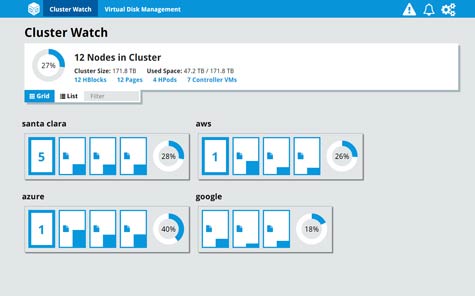
Taking the concept of software-defined storage to its next logical conclusion, Hedvig today announced it is developing a Universal Data Plane as part of an update to the Hedvig Distributed Storage System that is designed to span storage systems running on premise and in the cloud.
Rob Whiteley, vice president of marketing for Hedvig, says rather than perpetuating the deployment of isolated storage systems on premise and now in the cloud, the time has come to provide IT organizations with a mechanism to manage all those systems as logically connected entities.
“We think IT organizations want to move in the direction of delivering data services,” says Whiteley.
In that context, Whiteley says that Hedvig is betting that IT organizations will want to manage storage in isolation from compute and networking to make it easier to deliver those data services wherever required. The move toward hyperconvergence works against that goal because storage winds up being too tightly coupled to compute and networking services. As a result, it becomes too difficult to scale storage independently of compute and networking, says Whiteley.
In addition, Whiteley notes, thanks to the rise of microservices and containers such as Docker, it will soon be possible to more easily port applications across both public and private cloud services running on premise.
Whiteley says the Universal Data Plane that Hedvig is developing will also make it possible for IT organizations to rely more on commodity storage hardware. One of the reasons that storage is expensive today is that IT organizations get locked into proprietary hardware platforms that allow storage vendors to mark up the cost of commodity components, says Whiteley.
Obviously, there’s a major philosophical debate underway about how best to manage storage going forward. Each IT organization will have to decide for itself where it wants to fall on the spectrum of arguments being put forward concerning how storage should be managed now and in the future. At the core of that debate, ultimately, is just how much an IT organization will want to think in terms of managing data versus the underlying storage systems where that data resides.
Save
Save
Save