


Just because IT organizations do things one way on premise doesn’t necessarily mean they should use the same approach in the cloud. One of the problems that IT organizations have today with agility is the simple fact that the application development and deployment process, otherwise known as DevOps, is too fragmented to easily manage. Cloud computing offers an opportunity to unify a lot of the DevOps processes.
Taking on that challenge in the cloud is CloudMunch, which today formally launched at the Amazon Web Services re: Invent conference the CloudMunch Platform. Described as a platform as a service (PaaS) for DevOps, CloudMunch Platform provides a set of cloud application and infrastructure management services that are initially available on top of Amazon Web Services.
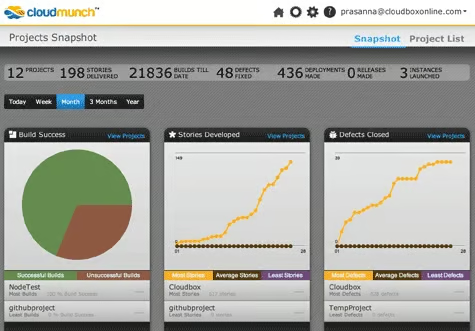
According to CloudMunch CEO Pradeep Prabhu, the company plans to extend its cloud management platform to cover both on-premise instances of cloud computing in addition to other cloud services besides Amazon. The issue that Prabhu says CloudMunch is trying to address is to allow organizations to unify the management of cloud computing before they get any more fragmented.
As part of the effort, CloudMunch provides a framework for not only managing and deploying applications in the cloud, but also managing the application development process. As a PaaS environment, Prabhu says the goal is to make every management function a single click by relying on as much automation as possible. In fact, Prabhu says the problem is not so much to unify DevOps as much as it is to have “NoOps” in the sense that application developers and managers should be able to seamlessly invoke IT infrastructure resources on an as-needed basis.
CloudMunch is that latest instance of a NoOps movement to combine IT automation and cloud computing in a way that abstracts the management of IT infrastructure to the point where the historic tensions that have existed between developers and IT operations teams essentially become a moot issue. The degree to which that will actually occur remains to be seen, but it’s already becoming pretty clear that software professionals working in the cloud are looking to use their skills to bypass IT operations teams that are hamstrung by cumbersome manual processes. At this juncture, the debate now seems to moving towards how long it will take for all this to occur, rather whether this can actually be done at all.