


Tibco this week announced the acquisition of StreamBase Systems, a provider of streaming analytics software that is used in real-time environments typically associated with complex events processing (CEP) applications.
According to Tibco CTO Matt Quinn, while streaming analytics today is usually associated with financial services applications, with the rise of Big Data, the technology will soon be applied across a much wider range of vertical industries.
Tibco has already made significant investments in CEP and analytics that Quinn says StreamBase will naturally complement.
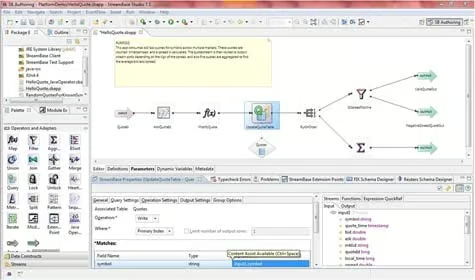
Quinn says what makes StreamBase unique is that the company created a visual programming language around the StreamBase streaming analytics platform that makes the underlying technology accessible. While streaming analytics technologies have been around for years, they have for the most part seen limited adoption because of the complexity associated with building analytics applications.
But now Quinn says IT organizations are confronting two types of Big Data problems. The first involved data at rest, which is where technologies such as Tibco Spotfire are applied. Data in motion, however, requires a streaming analytics capability that leverages historical data to predict future outcomes based on real-time events.
Quinn adds that in order to effectively deal with massive amounts of data in real time, IT organizations will have to rely more on CEP to hide the complexity associated with processing that amount of data in parallel.
In general, Big Data is forcing a parallelization issue that many IT organizations have long ignored. It’s simply not possible to sequentially process massive amounts of data, which means IT organizations are increasingly going to have to find frameworks for processing massive amounts of data in real time in a way that masks all the underlying complexity associated with parallelization.
Unfortunately, a lot of IT organizations are going to come to terms with that via hard-won experience rather than putting in place a Big Data architecture that truly scales into the future.