
Salesforce today announced it is making it possible for administrators and developers alike to create custom artificial intelligence (AI) models using the company’s Einstein platform.
In addition, Salesforce announced that customers can now embed analytics created using Einstein AI models into third-party applications such as supply chain and finance applications.
Finally, along with a language translation capability created using machine learning algorithms, Salesforce also revealed it has added an optical character recognition capability based on machine learning algorithms that turns unstructured data into structured data that can be consumed by AI models.
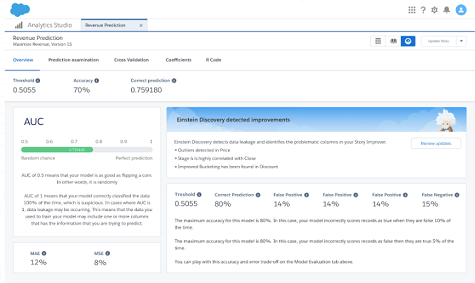
Allison Witherspoon, senior director of product marketing for Salesforce Einstein at Salesforce, says by making it possible for administrators and developers to create AI models using the company’s Lightning low-code development tools without the aid of a data scientist, Salesforce expects the number of organizations that will be able to add AI capabilities of a process based on its SaaS applications to expand considerably.
At the same time, Salesforce expects that AI models developed for its customer relationship management (CRM) software will become much more widely embedded within business processes spanning multiple enterprise-class applications. The only way to achieve that goal at scale, however, is to make it simpler for organizations to create and share AI models without having to find, hire and retain data scientists that command six-figure salaries and take a year or more to create an AI model.
“Within the next four years, there will be 10 million Salesforce administrators and developers,” says Witherspoon. “Einstein will make it possible for them to skill up.”
While most of the practical use case cases for AI are confined to well-defined tasks, it is clear that AI will soon become a ubiquitous element of almost every business process. Versus becoming too wrapped up the AI hype, the real challenge organizations face now is determining precisely where best to apply an AI model to reliably automate a task in a way that is truly free of any bias.