
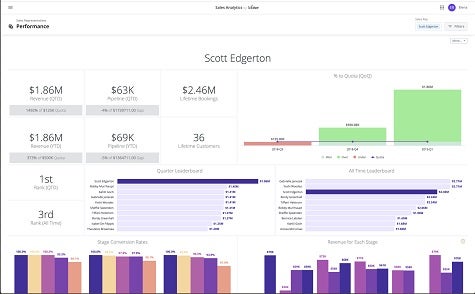
Looker this week extended its campaign to add versions of its analytics applications targeted at specific types of users with the beta release of Looker for Sales Analytics. Aimed at sales teams, this latest iteration of the Looker offering complements versions targeted at digital marketers and web site managers that are now both generally available.
In addition, Looker is making available a JavaScript Embed software development kit to enable developers to embed Looker analytics inside other applications.
Finally, Looker announced it is making available additional waterfall, box plot, trellis and word cloud visualizations, in addition to making available tools developed by Looker as open source code.
Daniel Mintz, chief data evangelist for Looker, says that while providers of customer relationship management (CRM) and marketing applications are embedding analytics capabilities, many organizations are finding that the depth of the analytics provided within those applications are not sufficient to meet their business needs.
To fill that gap, Looker has been extending its core platform with a series of applications running on its cloud service that enable, for example, users to analyze data in a CRM application against data residing in over 46 different types of database sources without having to move data, says Mintz. Looker accomplishes that goal by employing a lightweight virtual data model that allows analytics to be run locally on each database and then presenting the end user with the aggregated results, says Mintz. Because of that capability, Looker is much more of a platform for processing analytics than it is a way to simply generate visualizations, adds Mintz.
The battle for control over analytics within enterprise IT organizations continues to swing back and forth between IT teams that have historically favored data warehouse and line of business units that frequently fund their own analytics applications. However, as analytics platforms continue to evolve, it is clear that an opportunity to meld the best attributes of a centralized approach to analyzing data with tools that are easy to master is finally starting to present itself.