
SHARE
Facebook X Pinterest WhatsApp

HPE Brings Natural Language Queries to IDOL Analytics Engine

5 Trends Impacting the Future of Machine Data Intelligence The ability to search unstructured data has been around for quite some time. Now, Hewlett-Packard Enterprise (HPE) today announced it has infused the HPE IDOL data analytic engine used to conduct those searches with natural language capabilities. Jeff Veis, vice president of marketing for Big Data […]

Written By
MV
Mike Vizard
Dec 6, 2016
Slide Show

5 Trends Impacting the Future of Machine Data Intelligence

The ability to search unstructured data has been around for quite some time. Now, Hewlett-Packard Enterprise (HPE) today announced it has infused the HPE IDOL data analytic engine used to conduct those searches with natural language capabilities.

Jeff Veis, vice president of marketing for Big Data platforms at HPE, says IT organizations can now use IDOL to allow end users to query any data source they care to expose via HPE IDOL, using queries they can type themselves without any intervention on the part of the internal IT organization required.

To achieve that goal, Veis says HPE reengineered IDOL around four cores, IDOL Answer Bank, IDOL Fact Bank, IDOL Passage Extract and IDOL Answer services, and a set of machine-learning algorithms that make it simpler for queries against unstructured data to be organized in a way that optimally responds to natural language queries in a conversational format.

“It’s designed to understand multiple variants of the same query,” says Veis.
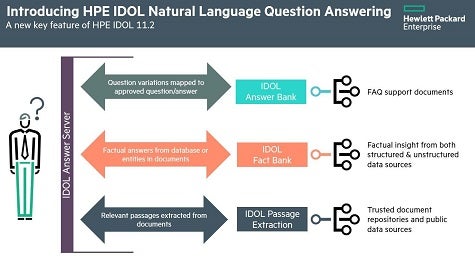
HPEIDOL

In fact, Veis says the HPE IDOL provides a simpler means for IT organizations to start making cognitive computing applications available to end users in a way that doesn’t require extensive training in a new application developed from the ground up.

HPE IDOL is part of the portfolio of software that will be transferred to Micro Focus, which has been reconstituted into a joint venture in which HPE is the majority owner. The HPE IDOL engine itself was part of the assets that Hewlett-Packard gained when it acquired Autonomy.

The degree to which natural language queries will become the dominant way end users interact with applications remains to be seen. But the more queries that get resolved using this approach, the less time IT professionals will need to spend finding data for end users who are likely to have forgotten the question by the time the IT department finds the answer.

Save

MV

Michael Vizard is a seasoned IT journalist, with nearly 30 years of experience writing and editing about enterprise IT issues. He is a contributor to publications including Programmableweb, IT Business Edge, CIOinsight and UBM Tech. He formerly was editorial director for Ziff-Davis Enterprise, where he launched the company’s custom content division, and has also served as editor in chief for CRN and InfoWorld. He also has held editorial positions at PC Week, Computerworld and Digital Review.

Recommended for you...

Data Lake Strategy Options: From Self-Service to Full-Service
Chad Kime
Aug 8, 2022
What’s New With Google Vertex AI?
Kashyap Vyas
Jul 26, 2022
Data Lake vs. Data Warehouse: What’s the Difference?
Aminu Abdullahi
Jul 25, 2022
IT Business Edge Logo

The go-to resource for IT professionals from all corners of the tech world looking for cutting edge technology solutions that solve their unique business challenges. We aim to help these professionals grow their knowledge base and authority in their field with the top news and trends in the technology space.

Property of TechnologyAdvice. © 2026 TechnologyAdvice. All Rights Reserved

Advertiser Disclosure: Some of the products that appear on this site are from companies from which TechnologyAdvice receives compensation. This compensation may impact how and where products appear on this site including, for example, the order in which they appear. TechnologyAdvice does not include all companies or all types of products available in the marketplace.