
SHARE
Facebook X Pinterest WhatsApp

Datameer Applies Data Governance to Hadoop

Capitalizing on Big Data: Analytics with a Purpose One of the biggest inhibitors to applying Hadoop in any production environment is the general lack of governance tools for IT organizations to use to manage access permissions for the data that resides there. To address that issue, Datameer today announced it has embedded a raft of […]

Written By
MV
Mike Vizard
Jun 3, 2015
Slide Show

Capitalizing on Big Data: Analytics with a Purpose

One of the biggest inhibitors to applying Hadoop in any production environment is the general lack of governance tools for IT organizations to use to manage access permissions for the data that resides there.

To address that issue, Datameer today announced it has embedded a raft of data governance tools inside its analytics software that runs natively on Hadoop.

Matt Schumpert, director of product management at Datameer, says that because its software runs in memory as a Hadoop application, responsibility for data governance within Hadoop naturally falls to Datameer.

To solve that problem, the company is providing access controls within Datameer and publishing open bi-directional REST application programming interfaces (APIs) through which governance metadata can be shared with either open source Apache Sentry authorization software running on Hadoop or any third-party data management software that can consume a REST API.
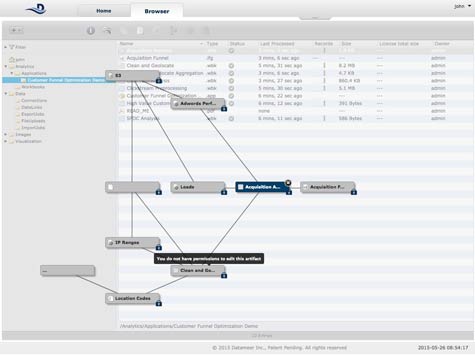
Datameer

The immediate goal, says Schumpert, is to provide a mechanism for data lineage that shows where analytics results originated and how data and analytics were used, modified or published via the Datameer user interface or the REST API.

Regardless of where the locus for data governance winds up being in the era of Big Data, IT organizations are going to need better governance tools. With more data than ever being collected in platforms such as Hadoop, the amount of sensitive data being actively managed by IT organizations will dramatically increase.

Of course, before any of that can happen, IT organizations still have to identify exactly who is responsible for making sure all those data governance policies are applied regardless of the actual size of the data in question.

MV

Michael Vizard is a seasoned IT journalist, with nearly 30 years of experience writing and editing about enterprise IT issues. He is a contributor to publications including Programmableweb, IT Business Edge, CIOinsight and UBM Tech. He formerly was editorial director for Ziff-Davis Enterprise, where he launched the company’s custom content division, and has also served as editor in chief for CRN and InfoWorld. He also has held editorial positions at PC Week, Computerworld and Digital Review.

Recommended for you...

Data Lake Strategy Options: From Self-Service to Full-Service
Chad Kime
Aug 8, 2022
What’s New With Google Vertex AI?
Kashyap Vyas
Jul 26, 2022
Data Lake vs. Data Warehouse: What’s the Difference?
Aminu Abdullahi
Jul 25, 2022
IT Business Edge Logo

The go-to resource for IT professionals from all corners of the tech world looking for cutting edge technology solutions that solve their unique business challenges. We aim to help these professionals grow their knowledge base and authority in their field with the top news and trends in the technology space.

Property of TechnologyAdvice. © 2025 TechnologyAdvice. All Rights Reserved

Advertiser Disclosure: Some of the products that appear on this site are from companies from which TechnologyAdvice receives compensation. This compensation may impact how and where products appear on this site including, for example, the order in which they appear. TechnologyAdvice does not include all companies or all types of products available in the marketplace.