

Best Practices for Choosing a Business Intelligence Dashboard

One of the fiercer debates roiling IT circles these days concerns the ultimate impact Hadoop will have on how data is managed and consumed across the enterprise. One view holds that Hadoop is a vast data lake that existing data warehouse applications will tap into by moving data into their own repository. The opposite view says that a new generation of analytics and visualization tools will emerge to eliminate the need to move any of the Hadoop data.
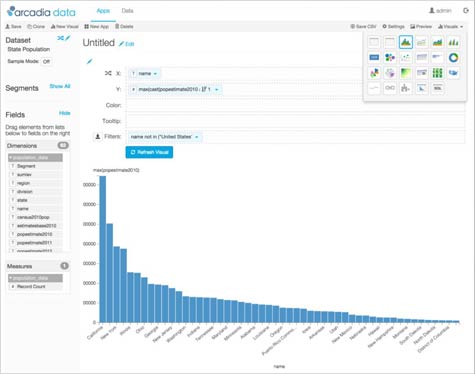
Firmly in the latter category, Arcadia Data today unveiled an enterprise edition of its business intelligence (BI) application, Arcadia Enterprise, which runs natively on Hadoop. Priyank Patel, chief product officer and co-founder of Arcadia Data, says the existing data warehouse stack is simply too complex to be sustainable. IT organizations not only have to move data from Hadoop into the existing data warehouse, they also have to create any number of data marts to make the data accessible to a BI application.
In contrast, Patel says Arcadia Enterprise runs on top of a low-cost Hadoop cluster to provide end users with an analytics application that enables them to launch queries against all the data residing in Hadoop instead of giving them access to only a subset of the data available.
One of the fundamental assumptions associated with investing in Hadoop is that once they are exposed to 100 percent of the available data, business executives will make better business decisions. For all the hype surrounding BI and analytics for the past decade, the underlying platforms on which those applications depend have only been serving up aggregates of data for them to launch queries against. The end result is often a set of data that doesn’t always jive well with what business executives know to be true about the business.
It may take several years for this debate to fully play out across the enterprise. But as more BI and analytics applications that natively invoke Hadoop become available, the rate at which the existing data warehouse stack will collapse will likely accelerate.