SHARE
Facebook X Pinterest WhatsApp

Skytap Helps IT Take Control of Hybrid Clouds

Integrating hybrid clouds that consist of multiple applications is one thing. But keeping two or more cloud instances running the same application synchronized with each other in a hybrid cloud environment represents a whole other level of complexity. Back to Basics: Objectives for Successful Cloud Adoption This week, Skytap is rising to the challenge by […]

Written By
MV
Mike Vizard
Jul 11, 2013

Integrating hybrid clouds that consist of multiple applications is one thing. But keeping two or more cloud instances running the same application synchronized with each other in a hybrid cloud environment represents a whole other level of complexity.

Slide Show

Back to Basics: Objectives for Successful Cloud Adoption

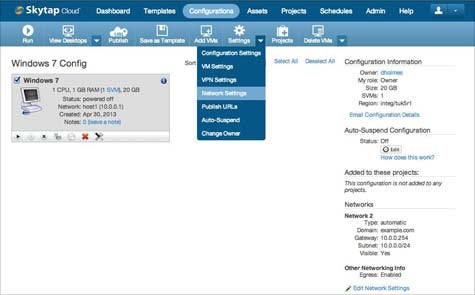
This week, Skytap is rising to the challenge by adding support for a Network Address Translation (NAT) capability that provides one-to-one mapping of IP and MAC addresses between different cloud instances.

According to Sumit Mehrotra, director of product management at Skytap, this capability is critical for any organization attempting to distribute applications among private, on-premise clouds and any third-party cloud service provider or between multiple data centers managed by the cloud service provider.

In addition to making it easier to keep multiple cloud instances synchronized, Skytap also provides a command line interface (CLI) to help manage applications running on the Skytap cloud. Mehrotra says this capability will give IT organizations more granular control over the Skytap cloud environment.

Finally, Skytap is also adding support for single sign-on capabilities that will make it easier for IT administrators to log in and out of multiple cloud environments.
viz20130711-01b

The best cloud service option is going to be the one that gives the IT organization the most amount of control over the environment. Many cloud service providers, of course, want to limit access to their environments to high-level RESTful application programming interfaces (APIs). But for many IT operations teams, that kind of high-level access to a cloud computing environment just isn’t going to cut it.

In fact, as cloud computing becomes just another tier of enterprise computing, there really is no reason why cloud environments shouldn’t be managed just  like an extension of the data center, as opposed to a completely different environment that the internal IT organization has little control over.

MV

Michael Vizard is a seasoned IT journalist, with nearly 30 years of experience writing and editing about enterprise IT issues. He is a contributor to publications including Programmableweb, IT Business Edge, CIOinsight and UBM Tech. He formerly was editorial director for Ziff-Davis Enterprise, where he launched the company’s custom content division, and has also served as editor in chief for CRN and InfoWorld. He also has held editorial positions at PC Week, Computerworld and Digital Review.

Recommended for you...

Observability: Why It’s a Red Hot Tech Term
Tom Taulli
Jul 19, 2022
Top GRC Platforms & Tools in 2022
Jira vs. ServiceNow: Features, Pricing, and Comparison
Surajdeep Singh
Jun 17, 2022
IT Business Edge Logo

The go-to resource for IT professionals from all corners of the tech world looking for cutting edge technology solutions that solve their unique business challenges. We aim to help these professionals grow their knowledge base and authority in their field with the top news and trends in the technology space.

Property of TechnologyAdvice. © 2025 TechnologyAdvice. All Rights Reserved

Advertiser Disclosure: Some of the products that appear on this site are from companies from which TechnologyAdvice receives compensation. This compensation may impact how and where products appear on this site including, for example, the order in which they appear. TechnologyAdvice does not include all companies or all types of products available in the marketplace.