

Flash Storage Architecture: What’s Available and Why It Matters

As part of an effort to make its storage and compute platforms accessible to a broader number of IT generalists, Hitachi Data Systems (HDS) today announced an update to its portfolio that employs much higher levels of automation.
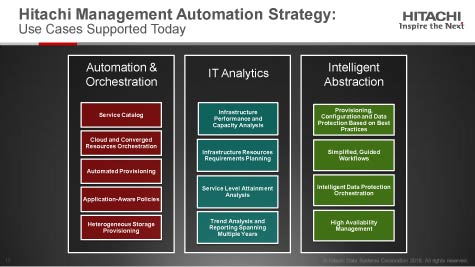
Paula Phipps, senior manager for software marketing at HDS, says that at a time when IT organizations are clearly signaling they don’t want to hire specialists to manage every aspect of an IT infrastructure environment, HDS is committed to making its server and storage platforms more accessible regardless of the size of the IT organization that employs them.
“IT automation makes it possible for organizations to rely a lot more on generalists to manage infrastructure,” says Phipps.
At the core of the HDS automation effort is a layer of software that pulls data from the HDS advisor software that HDS is moving to incorporate in all its UCP platforms. The newest instances of those platforms now include support for the latest class of Intel Broadwell processors as well as more Flash memory. In addition, HDS now supports the OpenStack cloud management framework of these platforms.
Finally, for those organizations that would rather rely more on HDS to manage their systems, there are now several more managed services available from HDS, including Storage as a Service (STaaS) and Compute as a Service (CaaS) offerings that make use of analytics applied by HDS to optimize IT operations.
At this juncture there’s no doubt IT infrastructure management is becoming more automated. Whether it’s to free up IT resources to deploy them elsewhere or simply cut operational and staffing costs, IT automation is going mainstream. The only real question now is whether it’s going to arrive embedded within new systems or get deployed as an overlay spanning multiple types of systems. Regardless of the path taken, the one thing that is for certain is that managing IT infrastructure will never be the same again.
Save
Save