
While the concept of desktop virtualization may not be all that new, applying virtualization to smartphones is still a twinkling in the eye for most enterprise IT organizations.
Looking to speed that process along, VMware recently released version 1.5 of VMware Horizon Workspace, which adds support for a range of VMware-ready smartphones based on the Google Android operating system.
According to Srinivas Krishnamurti, senior director of mobile solutions for VMware, in terms of mobile computing, extending the reach of VMware Horizon Workspace is still a work in progress. VMware, for example, clearly intends to add support for Apple iOS 7. The goal, says Krishnamurti, is to give IT organizations a single platform through which they can manage virtualization on everything from desktop PCs to smartphones.
As an extension of the VMware Horizon Suite, the latest mobile computing platform from VMware is designed to allow IT organizations to cleanly delineate between corporate applications running on a smartphone and the personal applications deployed by the end user. Rather than allowing those lines to blur, Krishnamurti says applying virtualization on the smartphone solves a range of security and compliance issues that continue to bedevil IT organization struggling with the whole Bring Your Own Device (BYOD) phenomenon as end users demand more access to corporate applications.
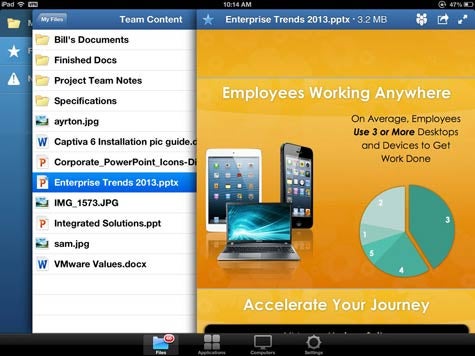
Krishnamurti says VMware Horizon Workspace is a better approach to mobile computing in the enterprise because it allows end users to access those applications in their native form, versus deploying some form or emulation or application wrapping technology that often forces a compromise on one piece of application functionality or another.
VMware obviously still has a little more work to do in terms of putting its mobile computing strategy in place. But as the company continues to expand its reach out to the desktop, it’s only natural that a lot of IT organizations are going to want to use that same approach to manage mobile computing devices that need to access the same enterprise applications.