
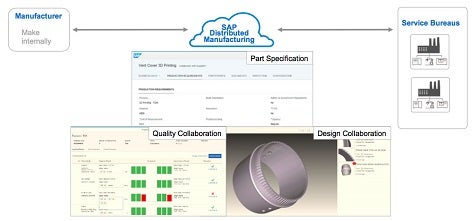
One of the reasons 3D printers are not more widely employed across manufacturing industries just yet is that there hasn’t been a way to seamlessly integrate them into a process. SAP is aiming to fill that gap with the release of SAP Distributed Manufacturing, an application through which manufacturing companies will be able to send orders directly to 3D printing services.
It’s part of SAP’s overall push into developing Internet of Things (IoT) applications, and Mike Lackey, global vice president of solution management, IoT and digital manufacturing, says interest in 3D printers to manufacture replacement parts is already running high. As the speed of 3D printers increases, Lackey says it’s only a matter of time before organizations start employing 3D printers more broadly to drive mass personalization into manufacturing processes at scale.
Lackey says SAP is working with both HP, Inc. and Jabil to integrate 3D printers into manufacturing processes, with the goal of plugging 3D printer services into the SAP Ariba business-to-business marketplace. SAP previously announced it is working with UPS to create such a 3D printer service. Those networks will be critical, says Lackey, because they will enable organizations to treat 3D printing as an operating expense versus having to acquire 3D printers on their own. The challenge now, says Lackey, is to incorporate 3D printer services seamlessly into existing supply chain processes.
“There will be a simplification of the supply chain using 3D printers,” says Lackey. “We can see a tremendous opportunity for cost savings.”
The degree to which 3D printers will disrupt traditional manufacturing remains to be seen. It’s still not practical to employ 3D printers to manufacture anything at scale. But as Lackey notes, 3D printers will enable manufacturers to develop new business models that over time will have a profound effect on the global economy as 3D printers enable more points of manufacturing to move much closer to the point where products are being purchased and consumed.