

Digital Integration: Overcoming Enterprise Data Challenges

By now most IT organizations are getting used to managing multiple types of databases. The challenge they now face is figuring out how many physical databases they need to deploy in order to support multiple types of application workloads.
Today MongoDB has made an update to its namesake database that natively supports graph analytics as well as a much faster implementation of SQL. MongoDB 3.4 also includes a faceted navigation and search tool, enhanced scaling across multiple geographic regions, and enhanced IT operations and security management tools.
Mat Keep, director of product and market analysis for MongoDB, says that document databases such as MongoDB have emerged as core database platforms alongside relational databases inside the enterprise. There are large numbers of application workloads that clearly lend themselves to a document database, which is typically easier to deploy and manage in an enterprise, says Keep.
“We’re seeing a lot of organizations offloading functions from a relational database,” says Keep.
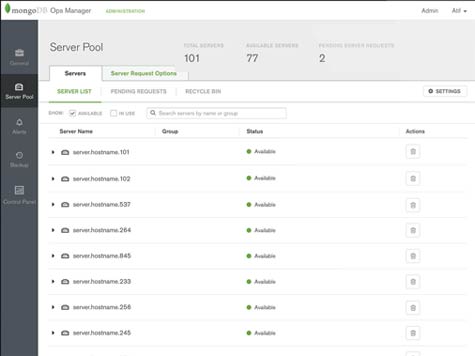
MongoDB is now trying to build on that adoption by making it simpler to embed analytics inside those application workloads without requiring IT organizations to deploy yet another database engine. That approach eliminates all the overhead associated with extract, transform and load (ETL) functions that IT organizations normally are required to manage when employing separate database engines, says Keep.
Most IT organizations got their first taste of a document database when a developer acting on his or her own initiative decided to bring one into the enterprise via the proverbial backdoor. But as usage of document databases has spread across the enterprise, IT operations teams are now being asked to manage far more instances of those databases than most of them might have ever initially imagined. That means that, like it or not, the time has now come for IT operations teams to figure out how to manage all those distributed instances of document databases regardless of what enterprise door they might have originally entered through.
Save
Save