
If you’re going to rely on a business intelligence (BI) application that runs in the cloud, it needs to be lightning fast in order to compensate for any network bandwidth issues that might be encountered.
With that issue in mind, BIME recently upgraded its core BI calculation engine to not only be able to support billions of data sets, it added support for Websockets as an alternative transport to HTTP in order to improve network performance.
According to BIME CEO Rachel Delacour, version 5.0 of the BIME BI software-as-a-service (SaaS) application that runs in-memory in the cloud makes use of new compression and caching algorithms that allow the application to fit much more data in-memory before. Queries are then automatically routed to any available node in the system.
In addition, BIME has updated the application connectors to improve the speed at which data can be accessed from multiple sources, which include Dropbox, Google Analytics, Vectorwise, Amazon Redshift, SAP HANA, Facebook and Salesforce.com. Those connectors also give customers the option of either hosting their data in a cloud service such as Google BiqQuery or storing it locally, says Delacour.
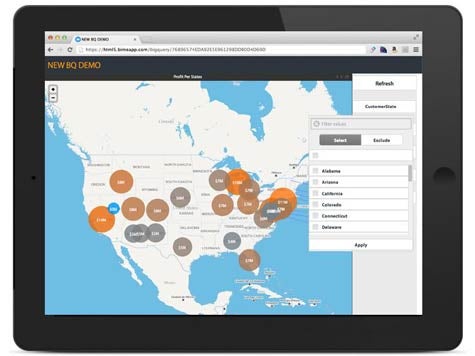
The BIME application itself can be rendered within a browser using HTML5 or Flash via a Haute Couture user interface that makes BIME accessible from a broad range of PC and mobile computing devices. It also includes a new Rendez-Vous feature that allows users to distribute dashboards via email.
BIME is at the heart of two converging application trends. The first is a shift toward in-memory computing that runs applications orders of magnitude faster than an application that depends on magnetic disk drives for I/O access. The second is rendering the application inside a browser to not only provide universal access, but also provide better security by making it easier to centrally manage data access.
IT organizations are likely to encounter any number of challenges when moving applications to the cloud. But as in-memory computing evolves alongside the robustness of browsers, what was once thought to be difficult to accomplish is becoming more than feasible.